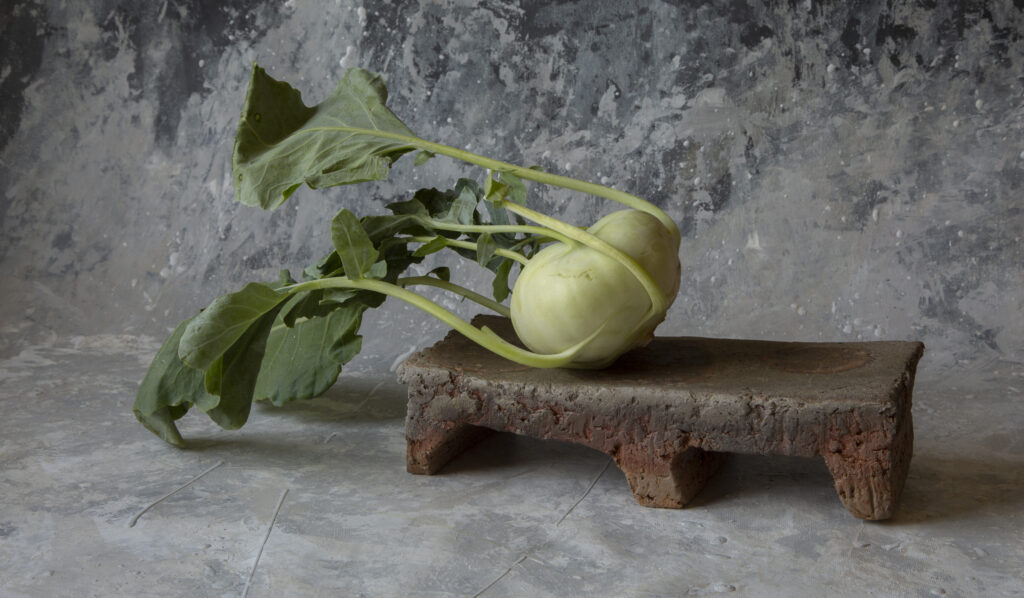
After a weekend of meeting and greeting people, showing what I have been making over the last few months, I feel a little like a kohlrabi, part cabbage and part turnip. I have told the stories of my first pots and what they were inspired from; asked what is on my bucket list. Primarily, I keep saying I want to continue making pottery as well as imaging beautiful ways of using pots. I keep changing as I look at objects, read, and weed. Thus, my solutions keep shifting. It’s hard to translate my ideas and process into bite size pieces.
“I’m just very suspicious of any kind of summing up of any kind of this is who I am. Because, first of all, who I am is changing rapidly all the time with what I’m reading, and who I’m with, and what I’m experiencing. And then the other thing is even I can’t sum up who I am. So I don’t know if I can trust someone else to do it.”
–Ada Limon from an interview on the Ezra Klein show, 5/24/2022
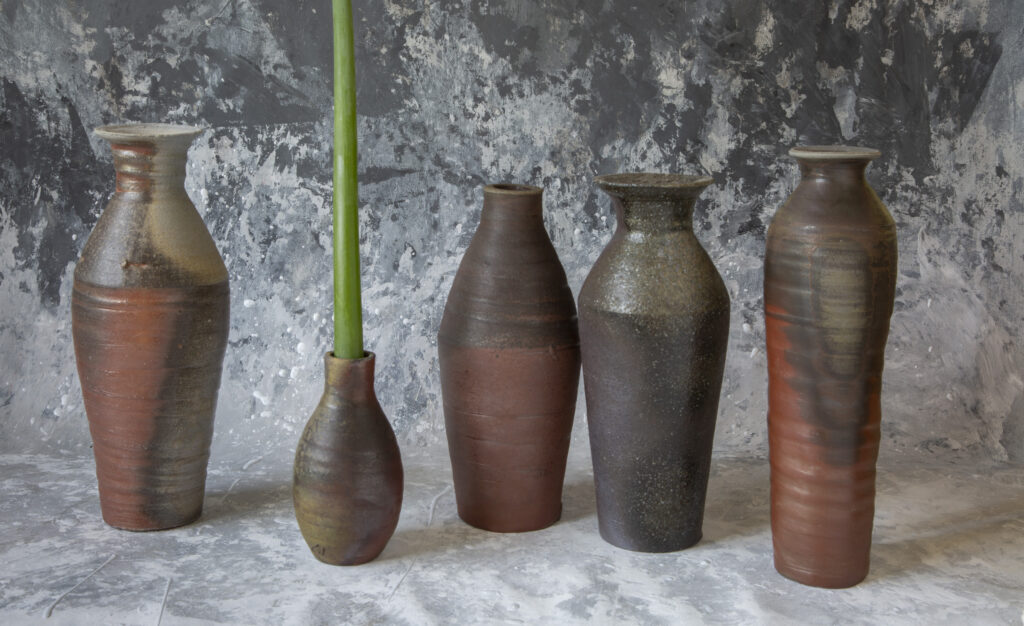
All my energy has gone into arranging pots and flowers; greeting old friends and making new ones. At the end of the day Warren walked Luna (the dog). Afterwards we sat outside on the swing and Luna rolled and rolled on her back as if to shake off the oomph of the day, happy to feel the grass and bask in the sky.
Optimism
More and more I have come to admire resilience. Not the simple resistance of a pillow, whose foam returns over and over to the same shape, but the sinuous tenacity of a tree: finding the light newly blocked on one side, it turns in another. A blind intelligence, true. But out of such persistence arose turtles, rivers, mitochondria, figs–all this resinous, unretractable earth.
–Jane Hirshfield, in Given Sugar, Given Salt, HarperCollins, 2001, p. 71
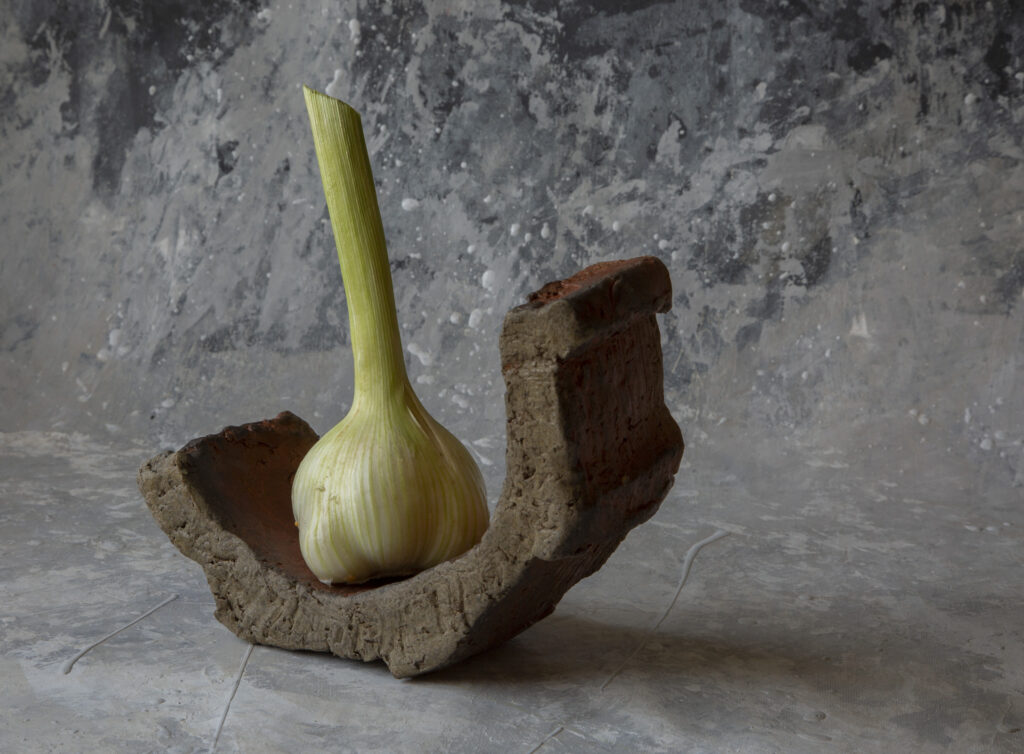
Today Warren and I hustled to get the gallery ready. We cleaned a few windows, clearing off dog and cat nose prints along with some toddler hand prints. We made sure paintings are signed, and that everything looks generally OK. At the end of the afternoon I took a few minutes to paint several bags. If one buys something during our open studio it is wrapped in a hand painted bag. This part of the preparation is always a delight for me. Afterwards Warren and I stood in the gallery space making sure everything was priced. I am terrible at this task, but the process reminds me to see the eloquence of each object, to slow down and identify what are my favorites and why. I am not sure if this is a delight muscle or a beauty radar.
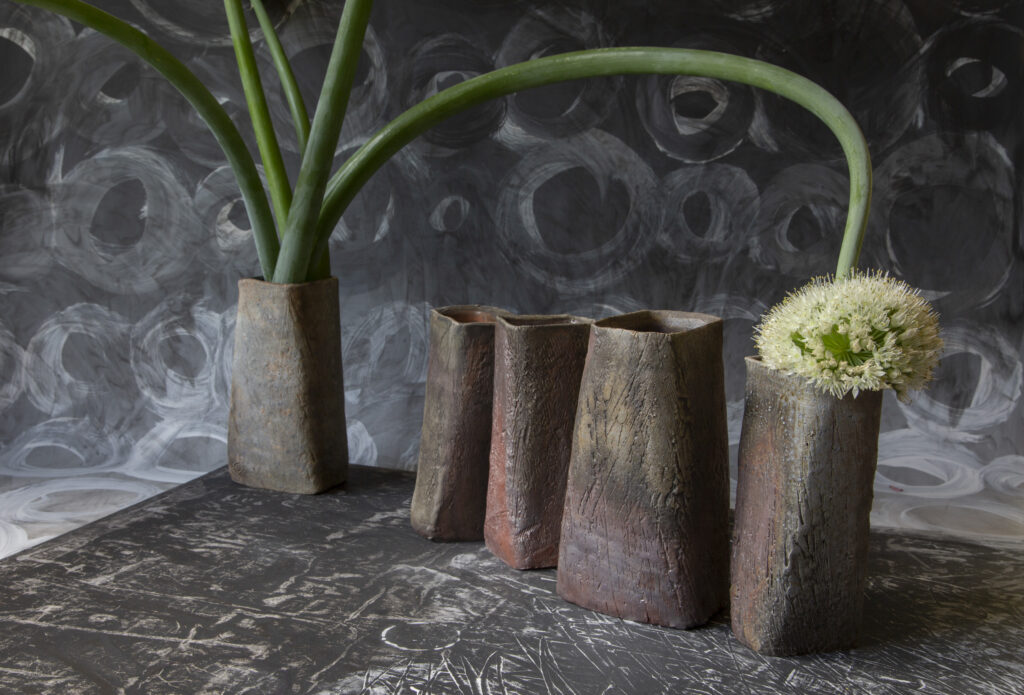
Elephant garlic
“It didn’t take me long to learn that the discipline or practice of writing these essays occasioned a kind of delight radar. Or maybe it was more like the development of a delight muscle. Something that implies that the more you study delight, the more delight there is to study.”
― Ross Gay, The Book of Delights, Algonquin Books of Chapel Hill, 2019, p. xii
While cleaning up for my exhibit/sale this weekend, I moved some photo books around and found an old picture of my mom in Maine weeding her flower bed when it was new. I was struck by how I have let the daylilies and the fireweed fill all the space. She loved those flowers. When I arrive in Maine, I admire the bees feasting on the purple fireweed, cheering those tiny wings that have flown from the mainland to our little island. When we spread my mom’s ashes in the ocean in Maine my dad first asked everyone to pick every blooming daylily. We put them in buckets and after we sifted the ashes into the sea, we tossed the lilies and watched them float away. The following morning, I walked the high tide mark hoping to find a flower tangled in the seaweed to press into my journal. But none were to be found. That’s what death feels like, you go looking for evidence of life and it is missing. With a heavy heart I walked up the path to the cottage and there in the garden all the daylilies were blooming again.
I bow closer to the new face. I am always superimposing
     a face on flowers, I call the violet moon vinca

the choir, and there are surely eyes in the birdeye speedwell,
     and mouths on the linearleaf snapdragon.

It is what we do in order to care for things, make them
     ourselves, our elders, our beloveds, our unborn.

But perhaps that is a lazy kind of love. Why
     can't I just love the flower for being a flower?

How many flowers have I yanked to puppet
     as if it was easy for the world to make flowers?

--Ada Limon, from In The Shadow, in The Hurting Kind, Milkweed Editions, 2022
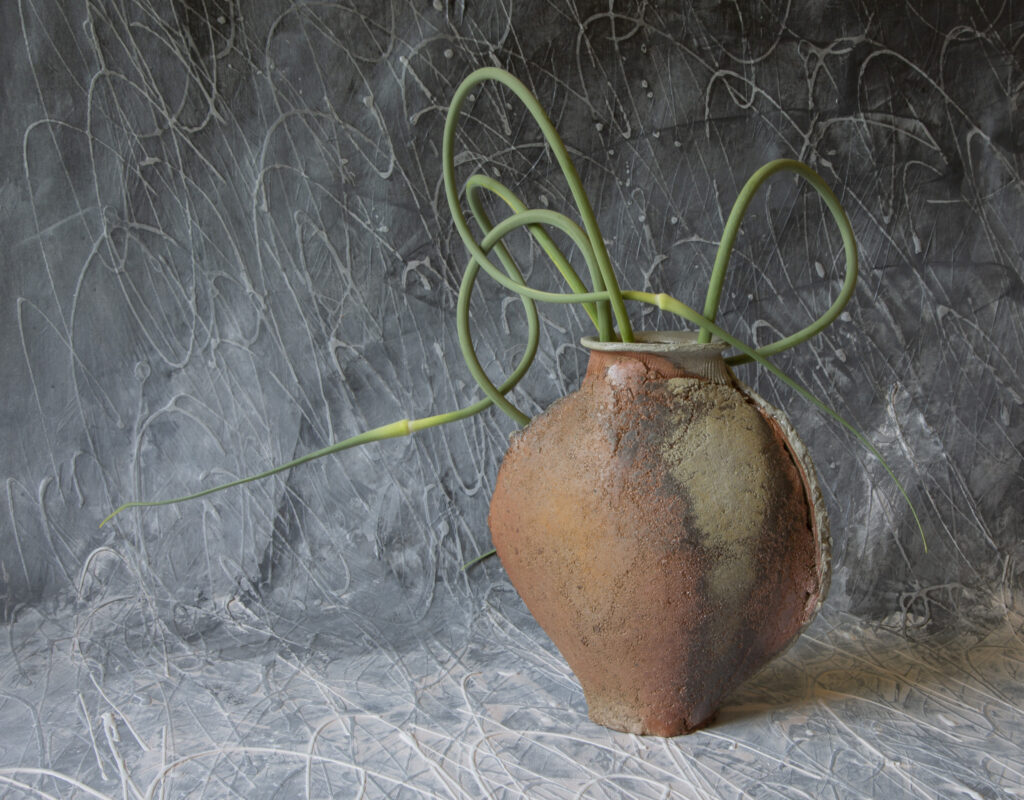
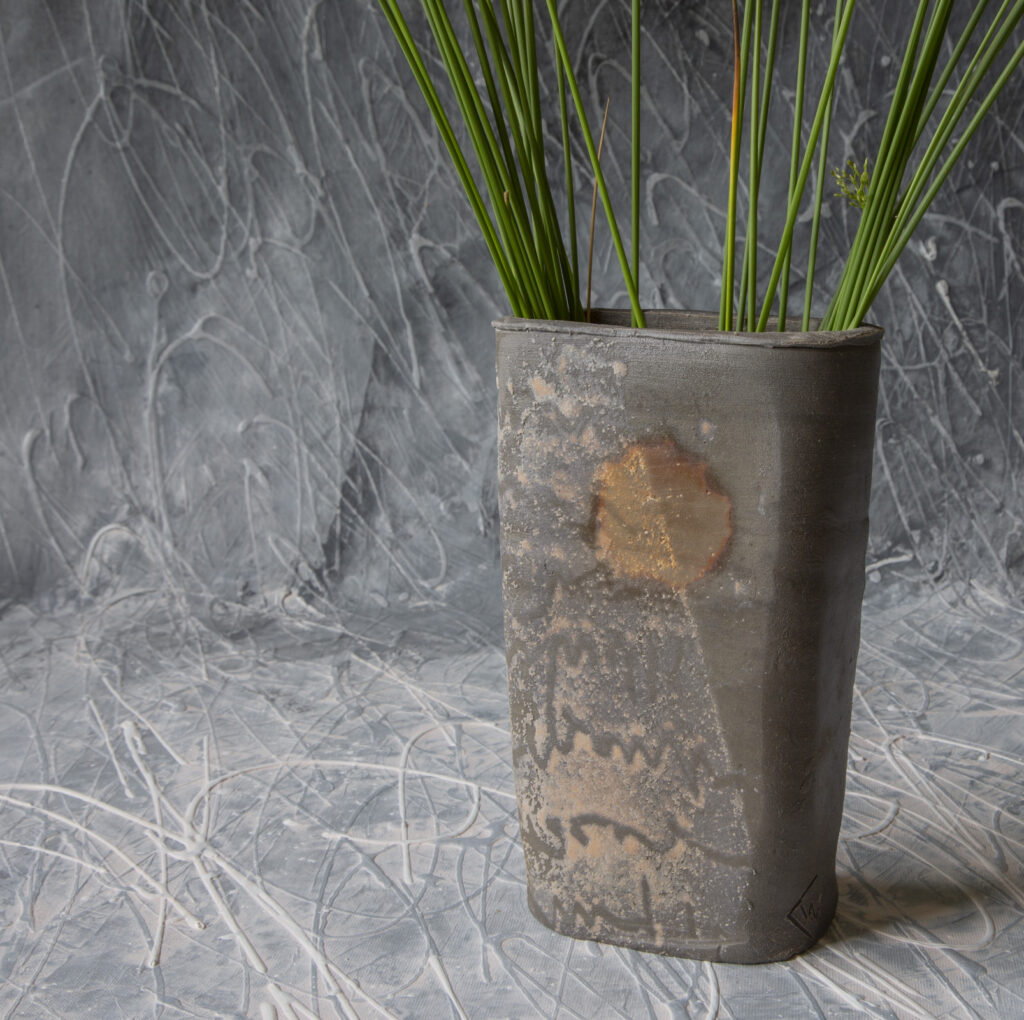
Often in June after dinner I walk up the driveway to see more sky. I walk to the edge of the road and admire a favorite tree and try to catch the sunset and perhaps a few fireflies. Today it’s smoky though not as smoky as it is north of us. Evidence of distance is magnified by the smoke. Back in the garden I have cut the scapes on this years scant garlic. Sometimes I feel like the exuberant loops of the scapes are made up brain waves and fancy loops of garden energy.
Garlic scapes
Nights when it’s warm and no one is watching, I walk to the edge of the road and stare at all the fireflies. I squint and pretend they’re hallucinations, bright made-up waves of the brain. I call them, field bling. I call them, fancy creepies.
–Ada Limon, from Field Bling, in Bright Dead Things, Millkweed Editions, 2015
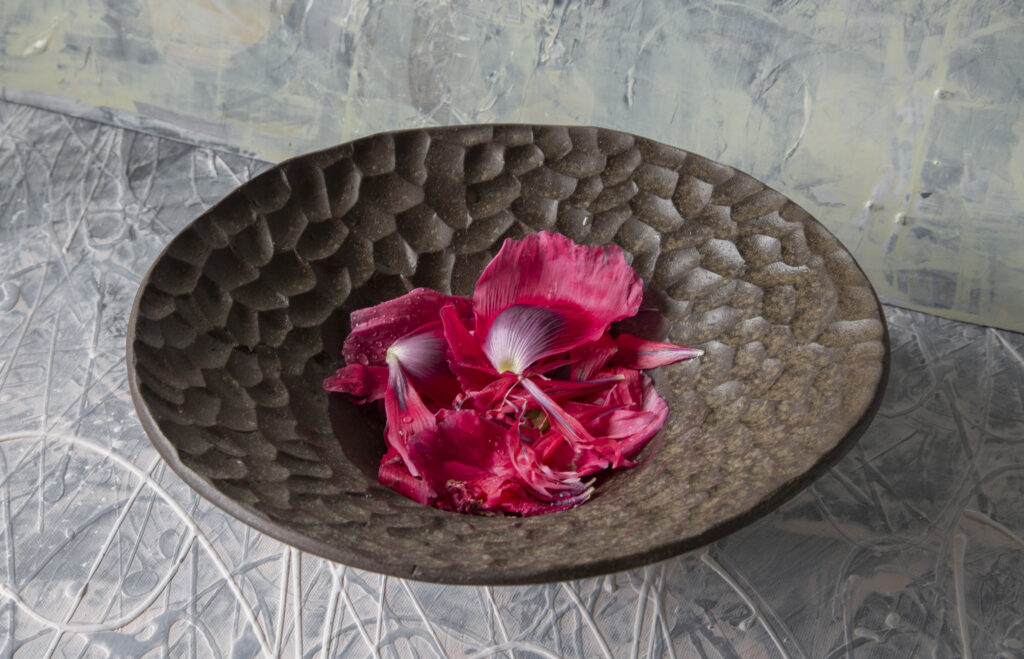
Sometimes I head into the garden thinking the project will be putting seedlings in the ground or weeding out all the invasive grasses, but instead I focus on the movement of the mustard, or the fallen poppy petals, the bluebird fledglings, or the cardinal beating himself up against the mirrors on our car. I am impressed by the ingenuity of the weeds and the generosity of the natural world. I am embarrassed by how weedy my fenced plot is. I will not show it to you, but I gather blossoms and shoots, peas and dandelions. I am full of intentions, artistic visions, and forgiveness.
Poppy petals
Let the subject be the movement of the goldenrod, the mustard, the cardinal, the jay, the generosity.
I don’t want anything, not even to show it to you—
the beak grass, bottlebrush, dandelion seed head, parachute and crown, all the intention of wishes, forgiveness,
this day’s singular existence in time, the native field flourishing selfishly, only for itself.
–Ada Limon, excerpt from The Rewilding, in Bright Dead Things, Milkweed Editions, 2015
This evening we watched the sunset, our eyes lingering on the field’s green edge. The conversation wandered and there were moments when each of us felt like stray cats, eyes bright as if we had said too much about the neighborhood or our deeply held emotions. But we turn and look again at the abundant green and feel lucky for where we have all landed.
Now, we take the moon into the middle of our brains
so we look like roadside stray cats with bright flashlight-white eyes
in our faces, but no real ideas of when or where to run.
We linger on the field’s green edge and say, Someday son, none of this will be yours. Miracles are all around. We’re not so much homeless
as we are home free, penny-poor, but plenty lucky for love and leaves
that keep breaking the fall….
–Ada Limon, from We Are Surprised in Bright Dead Things, Milkweed Press, 2015
Recently the poet laureate Ada Limon was requested by NASA to write a poem to be etched on the outside of a spacecraft named Europa Clipper, partly named after one of Jupiter’s moons to which it will travel on an almost two billion mile journey. The poem and spacecraft will not reach its destination until 2030, six years after its launch. I often think that potters have to see into the future. We have to imagine how our pots will shrink and transform in the heat and accept the surface changes and color shifts– but the idea of peering six years into the future is a whole other realm.
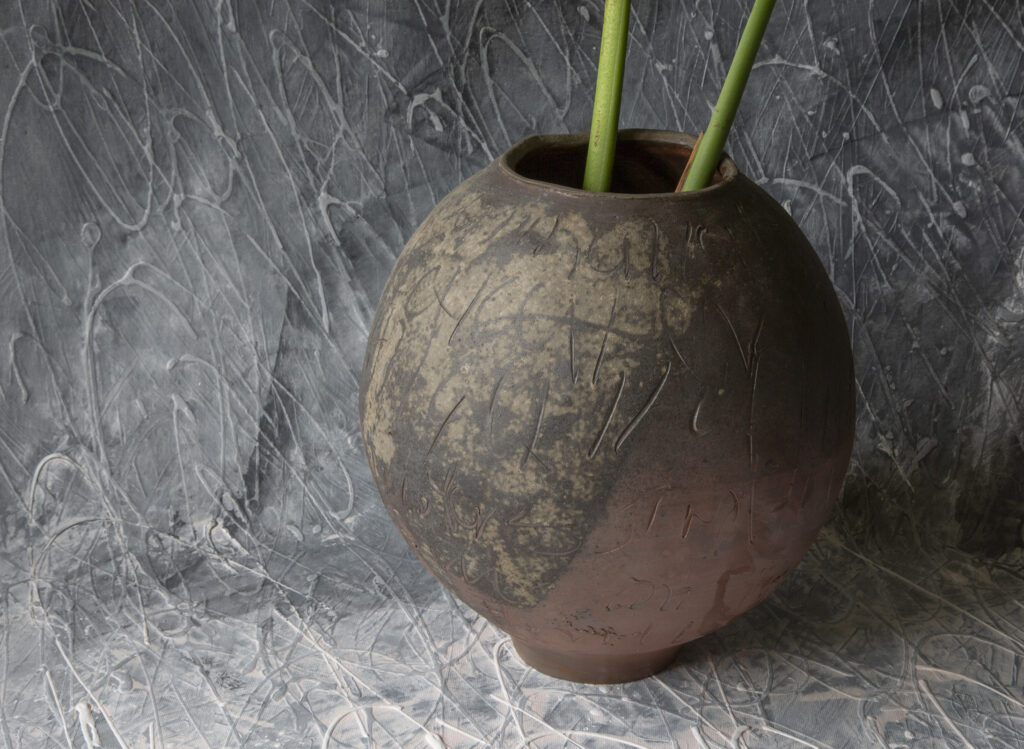
There are pots I inscribe with poems, often poems my mother wrote twenty-plus years ago. These poems are usually printed and appear backwards in my loopy handwriting. Or sometimes I inscribe directly on the surface with a loose touch. I want my words to be abstracted. I expect the observer/user knows there is hidden meaning. I hope the illegibility adds to the wonder as if small invisible words on a moon shaped vase call out into the dark. I read that Ada Limon practiced writing her poem by hand nineteen times until she got it right so that NASA could transcribe her actual handwriting onto the vessel. I still wonder how it will be transformed as it moves through the atmosphere, through the heat , cold, and time of space travel. Perhaps only a slight poetic variation from the heat, space and time of a kiln.
Asemic Moon Vase
Arching under the night sky inky
with black expansiveness, we point
to the planets we know, we

pin quick wishes on stars. From earth,
we read the sky as if it is an unerring book
of the universe, expert and evident.

Still, there are mysteries below our sky:
the whale song, the songbird singing
its call in the bough of a wind-shaken tree.

We are creatures of constant awe,
curious at beauty, at leaf and blossom,
at grief and pleasure, sun and shadow.

And it is not darkness that unites us,
not the cold distance of space, but
the offering of water, each drop of rain,

each rivulet, each pulse, each vein.
O second moon, we, too, are made
of water, of vast and beckoning seas.

We, too, are made of wonders, of great
and ordinary loves, of small invisible worlds,
of a need to call out through the dark.

--Ada Limon, In Praise of Mystery: A Poem for Europa, requested by NASA; to be engraved on the side of the Europa Clipper on its mission to Jupiter
I did a drive today I have done many times over the last thirty years. I always notice new buildings, dirt piles, and traffic changes. But today I recalled all the times I have driven north across the Potomac River at Point of Rocks just as the leaves unfurled and a green skin grows over the changes in the landscape. Home again to walk the dog, admire the weedy garden, bring a few things into the studio where I have a hand painted sign that reminds me to “keep going” — and yes I’ll take it all.
When all the shock of white and taffy, the world’s baubles and trinkets, leave the pavement strewn with the confetti of aftermath, the leaves come. Patient, plodding, a green skin growing over whatever winter did to us, a return to the strange idea of continuous living despite the mess of us, the hurt, the empty. Fine then, I’ll take it, the tree seems to say, a new slick leaf unfurling like a fist to an open palm, I’ll take it all.
–Ada Limon, from Instructions On Not Giving Up in Poem-a-Day, 5/15/2017
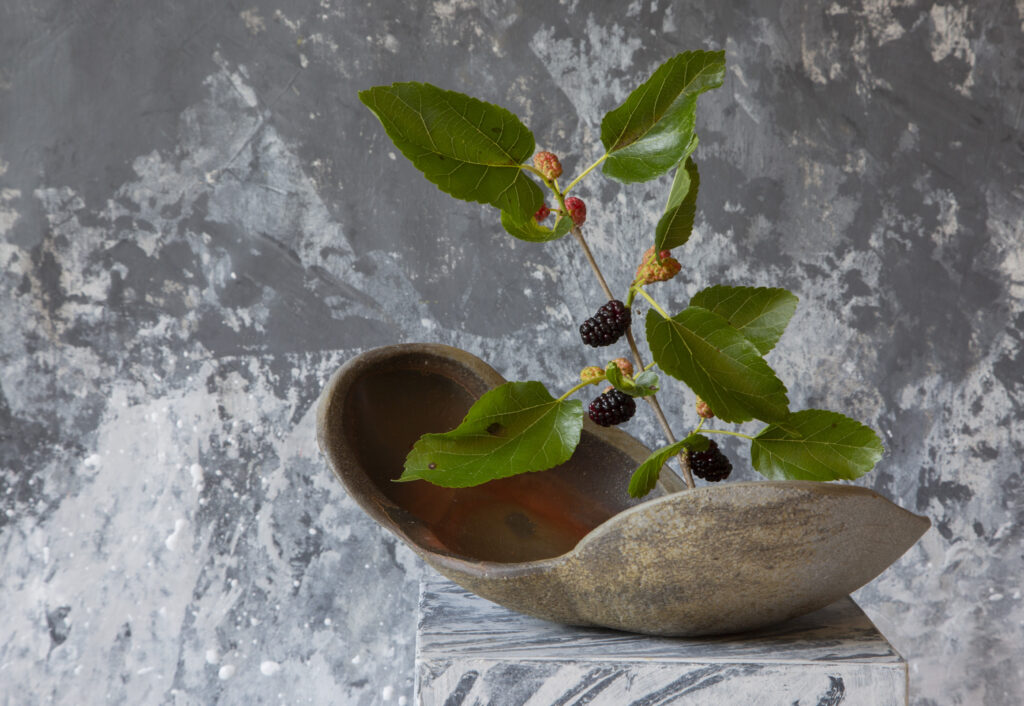
In late winter we cut down a big mulberry tree at the back, north side of our house. It had gotten too big for its spot. Shading the deck and dropping mulberries all over, making a big mess, it attracted wildlife, lots of wildlife. I could live with the deer and the birds and the squirrels. But it was more alarming when I saw a bear out the back door with a cub. However, what pushed me over the edge last summer was when we routinely had a skunk off the back deck eating mulberries. My young impulsive dog was sure to get skunked before long.
A few years ago I asked our tree arborist about cutting it down but he persuaded us that too much wildlife depends on the tree. I lived with the tree for a few more years as it cast ever more shade and dropped more berries until the skunks rejoiced. I feel slightly guilty that I got someone else to cut it down, but they could remove it, a task beyond us these days. Today I walked around our property identifying which of our other mulberries bear fruit and which ones are males without fruit, relearning the fact that not all mulberries bear fruit. I said hello to groundhogs, squirrels, a young buck with fuzzy nubs of horns, and listened to the birds. I feel better now having relearned the habits of the mulberries. When I surprised the buck in multiple locations he looked up as if to say you caught me purple-mouthed. A nice variation on the old phrase caught red-handed as if smeared with guilt in the act of stealing delicious fruit. Now that I investigate the trees further from house and garden I am happy to share.
Purple-Handed
Which the phrase red-handed, meaning caught in the act, meaning smeared with guilt, out out damned spot, is a bastardization of, given as purple-handed is the result, this time of year, of harvesting mulberries, which Aesop’s ant might do with freezer bags or Tupperware, but, being sometimes a grasshopper, I do with my mouth, for that is one of the ways I adore the world, camped out like this beneath my favorite mulberry on cemetery road, aka Elm Street, aka, as of today, Mulberry Street, the wheel of my bike still spinning, as the pendulous black berries almost drop into my hands, smearing them purple and sweet, guilty as charged.
–Ross Gay, in The Book of Delights, Algonquin Books of Chapel Hill, 2019, page 215.