Month: June 2025

  • #11 summer shards 2025

    When I began doing these seasonal series I used the alphabet and bits from my childhood dictionary as prompts to create collaged images. So, it’s no wonder that I was drawn to a project that Alex Dimtrov did in 2012 where he posed 26 questions, one for each letter of the alphabet. His goal was to write poems that were portraits of people he did not know. But instead of poems he made collages. He also read more than he wrote. I similarly give myself assignments as a way to keep going, to keep asking questions, to keep putting things in my pots, and to keep taking photos.

    Poem for the Reader

    Since we’ll likely never be together
    anywhere but here — what season
    are you most alive in?
    Is the morning blue or green?
    How would you use freedom?
    What part of your body do you trust the least?
    Permanent rain or never-ending snow?
    When are your most difficult hours?
    Would you want to know who you were
    before this? Why or why not?
    And now that there’s fire —
    the bridge or the river?
    More money or love?
    Do you sometimes avoid happiness?
    If asked, would you return?
    To Earth or anywhere else?

    –Alex Dimitrov, on his Substack, The Reader

  • #10 summer shards 2025

    I did an online yoga class this morning. The teacher is the sister of an old friend. I enjoyed her view into familiar poses. As we balanced in tree pose I studied my back deck and the beech tree beyond. I noticed not only the marigolds in my outdoor pots, but a crow balanced in a branch.

    My Crow

    A crow flew into the tree outside my window.
    It was not Ted Hughes’s crow, or Galway’s crow.
    Or Frost’s, Pasternak’s, or Lorca’s crow.
    Or one of Homer’s crows, stuffed with gore,
    after the battle. This was just a crow.
    That never fit in anywhere in its life,
    or did anything worth mentioning.
    It sat there on the branch for a few minutes.
    Then picked up and flew beautifully
    out of my life.

    –Raymond Carver, this poem appeared in All of Us: The Collected Poems by Raymond Carver, published by Vintage Books, 1996.

  • #9 summer shards 2025

    I am often afraid of being stuck in ruts and repeating myself. I fear that I use the same plant material over and over each season. I try not to repeat the same shape or backdrop, but this afternoon as I wandered in my garden I thought, maybe there is value to mining what comes naturally, that which is in my own backyard.

    Lamb’s Ear

    While she [Ruth Asawa] was at Black Mountain College, she confessed to her mentor Josef Albers, that she wanted to paint flowers instead of pursuing the more formal, abstract work popular at the time. He told her, “You can paint flowers, but make sure that they’re Asawa flowers.”

    –From a wonderful commentary by Wendy MacNaughton in her Draw Together newsletter. The quote comes from an oral history interview with Ruth Asawa and her husband, Albert Lanier, June 21-July 5, 2002 (Archives of American Art, Smithsonian Institution).

  • #8 summer shards 2025

    I taught a workshop this weekend. As I prepared, I revisited my established ideas of making, some rules of thumb, along with recent inspirations. There are so many jumping off points to hone one’s own voice. We are lucky if we get to let it bloom.

    “I was a late bloomer. But anyone who blooms at all, ever, is very lucky.”

    –Sharon Olds commenting on publishing her first book of poems at age 38.
    See a description at The Writer’s Almanac (last section)

  • #7 summer shards

    Placing flowers in my pots, arranging them on backdrops, and taking photographs creates a conversation with my pottery, a dialog that leads to future variations in form and surface.

    “Writing is a conversation with reading; a dialogue with thinking.”

    –Nikki Giovanni, quote from her book, Racism 101

  • #6 summer shards 2025

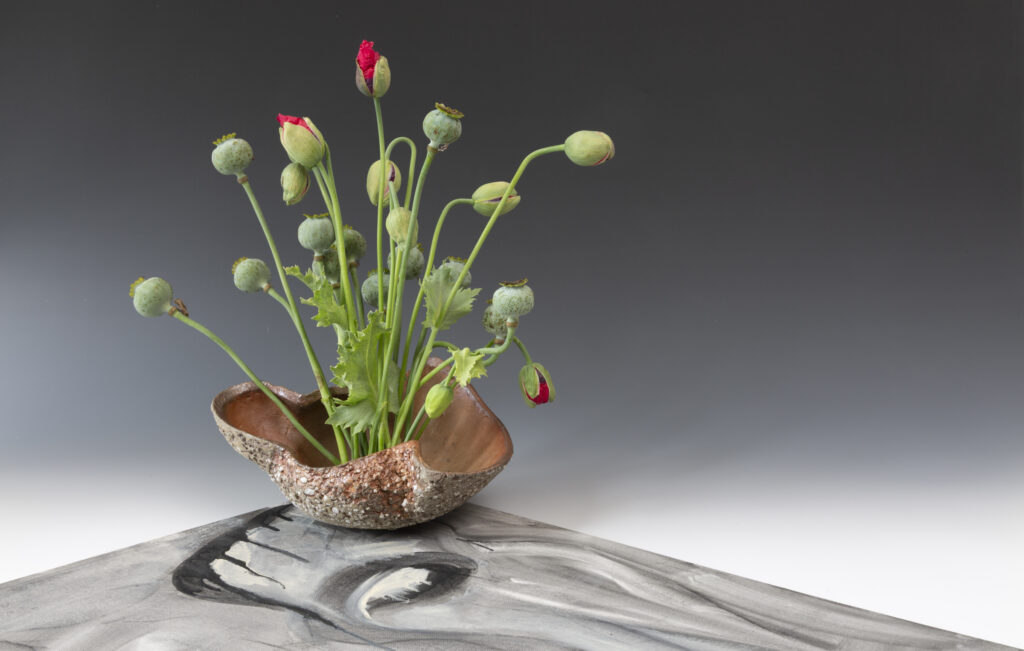
    I often buy my own flowers. Warren knows I love them but it is not his language. Recently, when we went to the grocery store together he reminded me to look at the flowers but I said, “No, now is the season of flowers in our garden or at the farmers market.” But then, as we stood in line to check out, I really admired the peonies the man in front of us was buying. So I went back and treated myself to the moon-like peonies.

    Listen,

    I want to tell you something. This morning
    is bright after all the steady rain, and every iris,

    peony, rose, opens its mouth, rejoicing. I want to say,

    wake up, open your eyes, there’s a snow-covered road

    ahead, a field of blankness, a sheet of paper, an empty screen.

    Even the smallest insects are singing, vibrating their entire bodies,

    tiny violins of longing and desire. We were made for song.

    I can’t tell you what prayer is, but I can take the breath

    of the meadow into my mouth, and I can release it for the leaves’
    
green need. I want to tell you your life is a blue coal, a slice
    
of orange in the mouth, cut hay in the nostrils. The cardinals’
    
red song dances in your blood. Look, every month the moon
    
blossoms into a peony, then shrinks to a sliver of garlic.

    And then it blooms again.

    –Barbara Crooker, “Listen,” from Line Dance,
    copyright © 2008 Word Poetry.

  • #5 summer shards 2025

    I have been thinking about how poems are read in our communities. Friends ask me how do I find the poems I use for this project and I say I just keep my ears open. Sometimes at a dinner or in a yoga class a topic will spark and someone will recite a poem from memory. But more often, poems seem to be shared at weddings and funerals. I wish we offered them up in more settings.

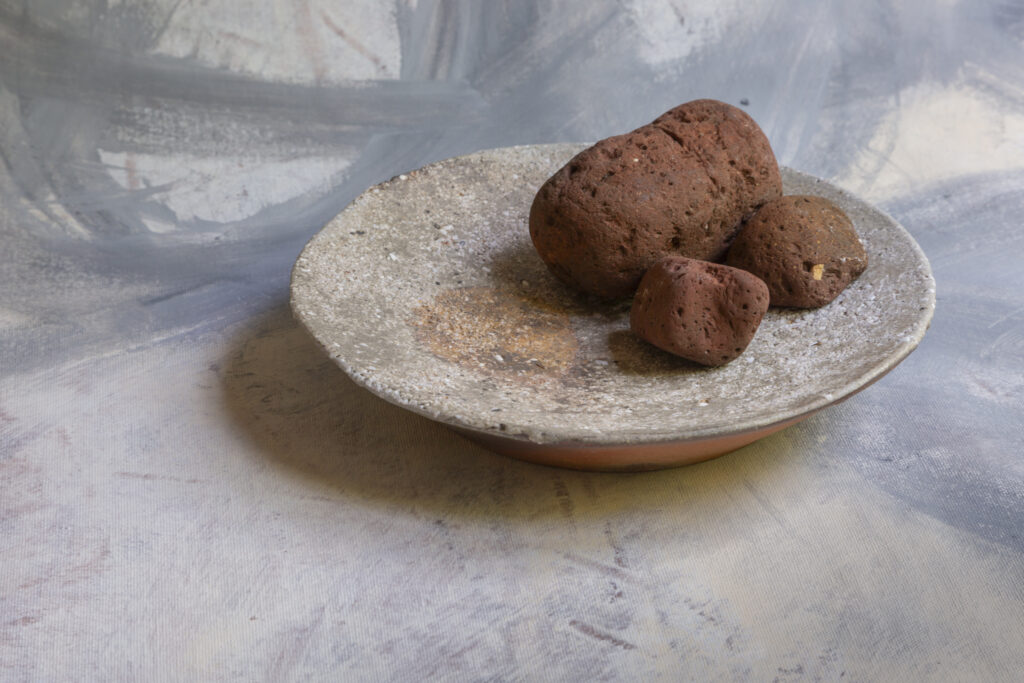
    My ocean worn bricks are listening. At a memorial today we have been sharing memories about our sculptor friend, John Daniel McCarty. He had an eye that recognized the weight of things. He made visual associations between scale and material that allowed us all to see with broader sensitivity and deeper connections. We shared a love of oysters from the Damariscotta River. I imagine the river stones are singing and the trees are leaning closer to hear us remember a sculptor and his love of place.

    Rock Me Mercy

    The river stones are listening
    because we have something to say.
    The trees lean closer today.
    The singing in the electrical woods
    has gone dumb. It looks like rain
    because it is too warm to snow.
    Guardian angels, wherever you’re hiding,
    we know you can’t be everywhere at once.
    Have you corralled all the pretty wild
    horses? The memory of ants asleep
    in daylilies, roses, holly, & larkspur.
    The magpies gaze at us, still
    waiting. River stones are listening.
    But all we can say now is,
    Mercy, please, rock me.

    –Yusef Komunyakaa, “Rock Me, Mercy” from The Emperor of Water Clocks,
    published by Farrar Straus and Giroux, Copyright © 2015 by Yusef Komunyakaa.

  • #4 summer shards 2025

    I walked this morning thinking about shadows. The green grass was muscular and the light was striking, although slightly muted by the Canadian wildfires. I and our dog, Luna, moved through the field, the path and along the road parting the grass and the air. We noted the shifts of shadow from the looseness of the knee-high grass to the clarity of mowed trail to the sharpness of the shadows on the paved road. Luna and I each have our reasons for moving and walking even if it only involves chasing our own shadows.

    Keeping Things Whole

    In a field
    I am the absence
    of field.
    This is
    always the case.
    Wherever I am
    I am what is missing.

    When I walk
    I part the air
    and always
    the air moves in   
    to fill the spaces
    where my body’s been.

    We all have reasons
    for moving.
    I move
    to keep things whole.

    –Mark Strand, Keeping Things Whole from Selected Poems, published by Alfred A. Knopf, © 1979, 1980 by Mark Strand

  • #3 summer shards 2025

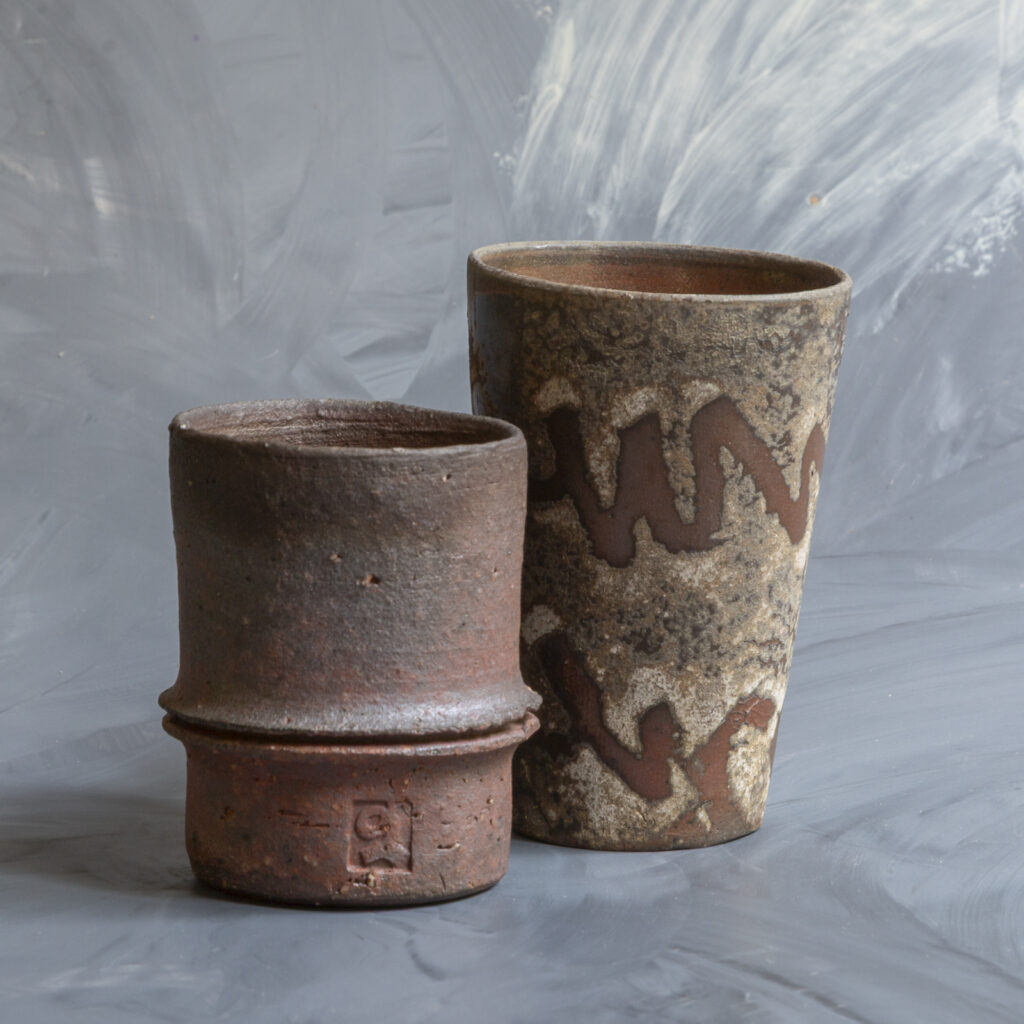
    Our friend, John Neely, died this weekend. At the North Carolina woodfire conference in 2022, for some an opportunity to showcase large pots and macho egos, John Neely exhibited a beautiful and sensitive selection of small woodfired cups. I tried to buy one but they were all sold. I told John how much I liked them and he offered to trade. So when we got home we each sent the other two cups. Warren and I have often treasured these small objects.

    John was an organizer and presenter at this year’s conference. Last week, each evening after the formal events of the conference, John happily filled everyone’s cups with liquids along with stories and laughs. I have no desire to go back to school, but sometimes I have wished I was a fly on the wall of his ceramics program at Utah State University. John’s former students seem to have gained so much and move through the world in great ways.

    The shock and sadness of John’s passing on Sunday has spilled through our nervous system.

    The cup exchange: John’s cup on the left; he received a cup similar to mine on the right.

    My Cup

    They tell me I am going to die.
    Why don’t I seem to care?
    My cup is full. Let it spill.

    –Robert Friend, from Dancing With A Tiger: Poems 1941-1998 (Spuyten Duyvil).

  • #2 summer shards 2025

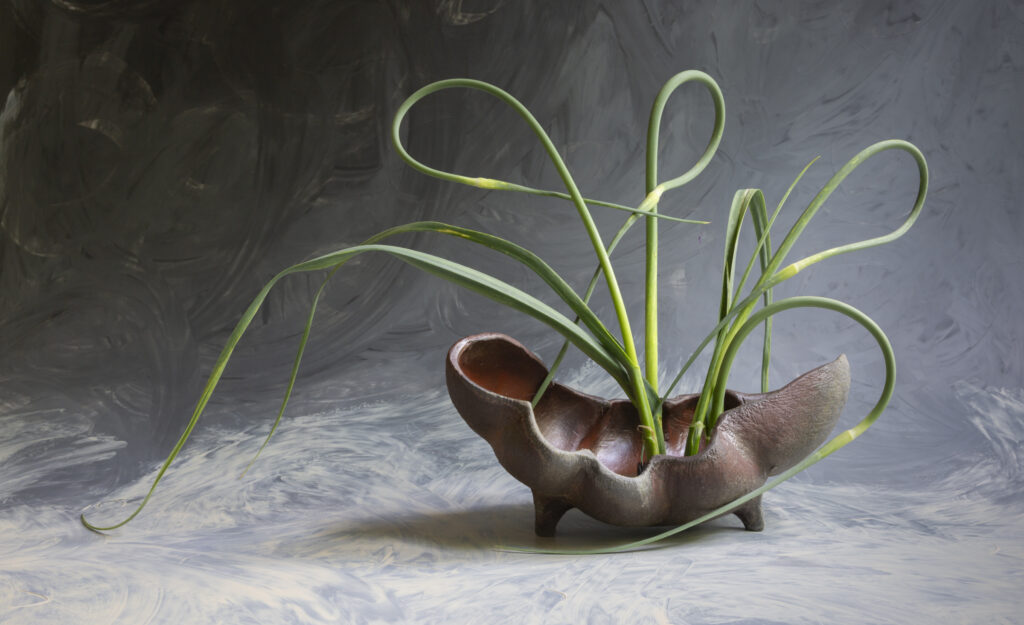
    Last week I was at a North Carolina woodfire conference where my job was to listen; to be part of the ecosystem of the clay world. Now back in the garden in the ecosystem of my home I am able to bury myself in the lush green leaves of kale and pick my favorite garlicscapes. I toggle between garden and studio attempting to be witness to the season.

    Sanctuary

    Suppose it’s easy to slip
    into another’s green skin,
    bury yourself in leaves

    and wait for a breaking,
    a breaking open, a breaking
    out. I have, before, been

    tricked into believing
    I could be both an I
    and the world. The great eye

    of the world is both gaze
    and gloss. To be swallowed
    by being seen. A dream.

    To be made whole
    by being not a witness,
    but witnessed.

    –Ada Limon, Sanctuary, in “The Hurting Kind”
    published by Milkweed Editions