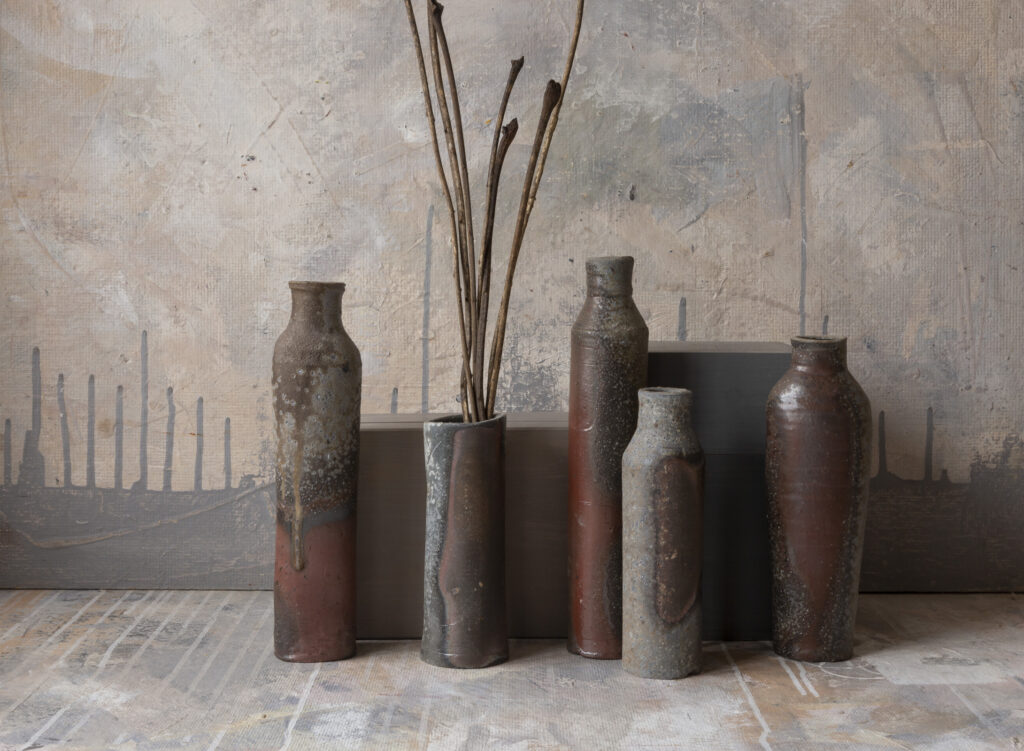
These December days as I walk my circles with a six month old puppy I notice the gaps–the blue sky between the grey clouds on a blustery evening, the spaces between the bare trees as much as the trees in the morning blush of sunrise. It reminds me of Morandi’s still lives. How he painted space as much as objects. He captured the void, the warp, the curve, the table, and the wall.
“ I have always loved the gaps, the spaces between things, as much as the things. I love staring, pondering, mulling, puttering. I love the times when someone or something is late – there’s that rich possibility of noticing more in the meantime . . . poetry calls us to pause. There is so much we overlook, while the abundance around us continues to shimmer, on its own.”
I do my decembrance project each year as a way to stave off my seasonal depression. In my fear of the darkening days I focus on the light. For years as I anticipate the shifting cycle of light I have been trying to find change in how I express myself. I aim to find new things to photograph. I make new backgrounds and alter how I approach my dread of the long nights.
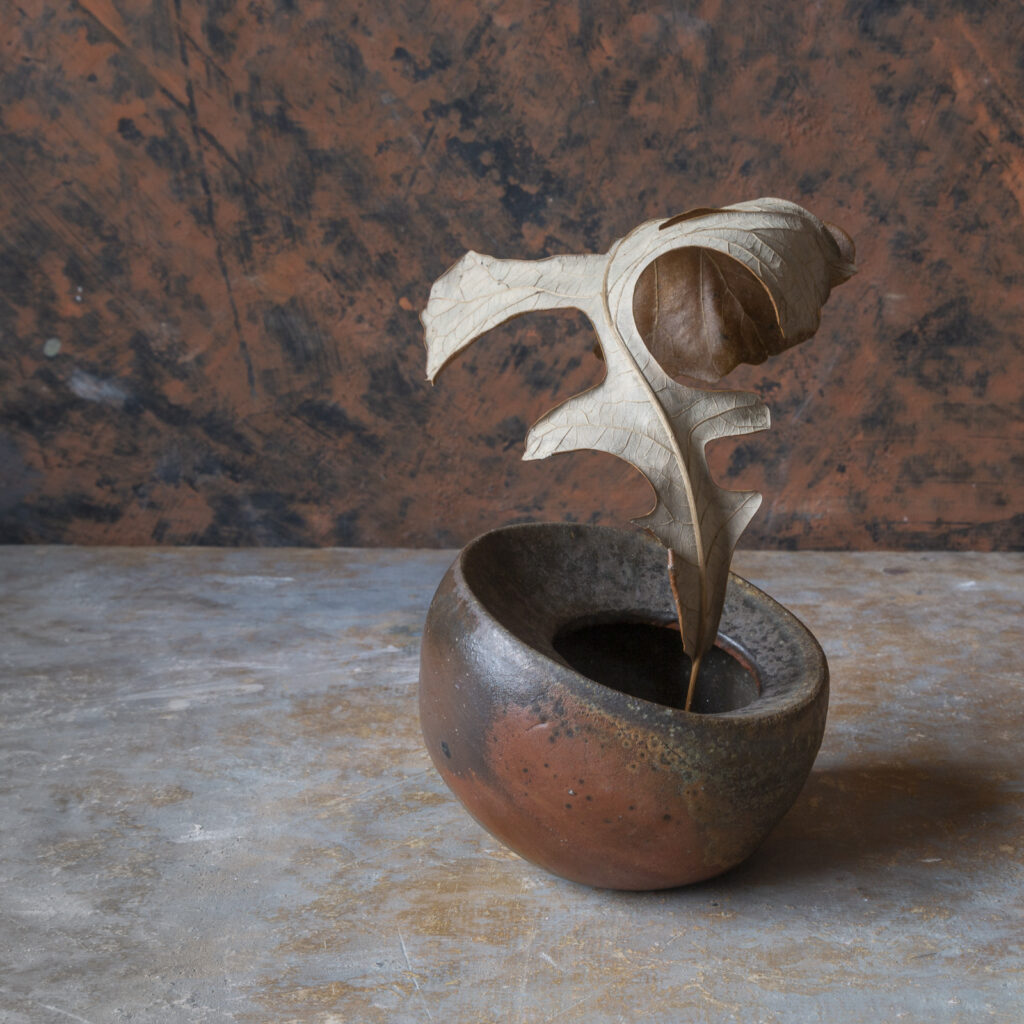
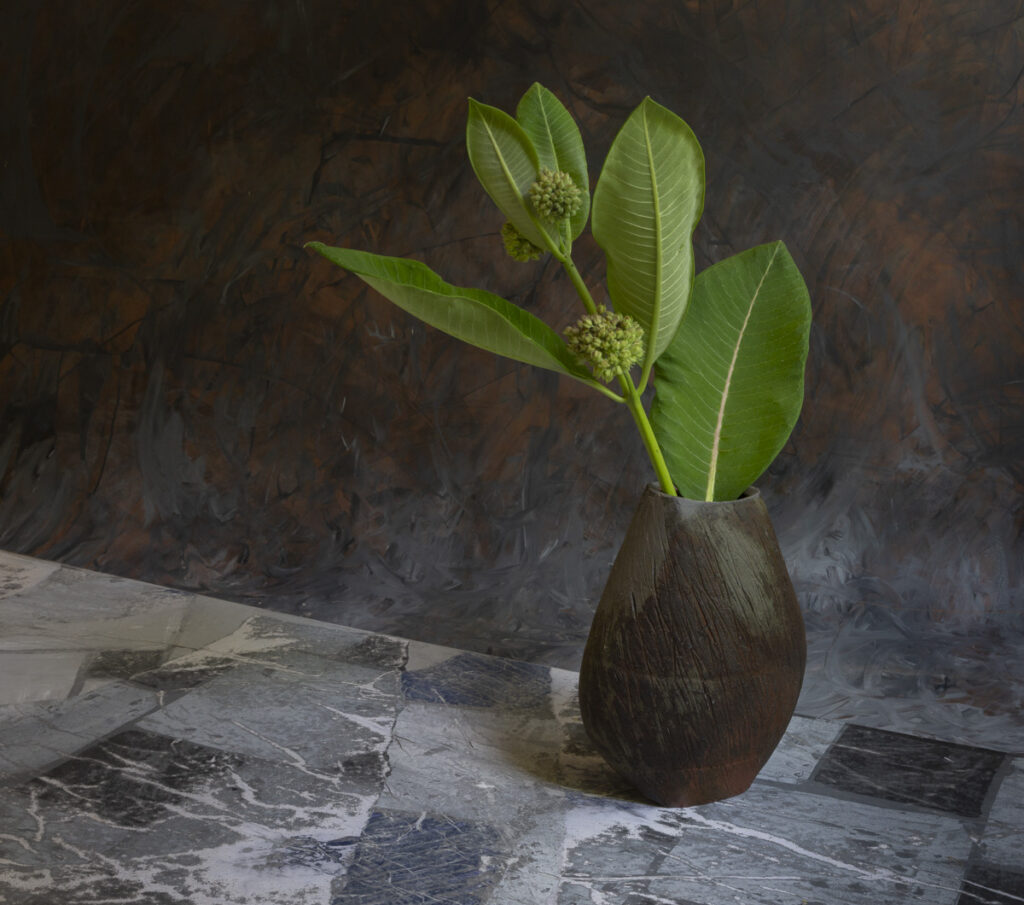
This year I have accepted that there are things I revisit like the Osage-orange or the cardoon, the magnolia leaf and the oak. This is my harvest. This is when I count the seeds, notice the cold and find ways to enjoy it. By writing and photographing I have learned that I no longer need to huddle on a cold November rock. I can count down the days until the shortest day of the year. It comes fast and then I can breath a little easier because I know we are building up day-by-day again. And through all this I have found that what I most love are the months when day and night are even.
Everything tends towards its own circumference, it seems — the world, This life, and no doubt the next, dependence and dear dread, Even the universe in its spare parts. As for me, I’m ringed like a tree, stealthily, year by year, moving outward.
— Charles Wright, from Buffalo Yoga in Oblivion Banjo, Farrar Straus Giroux, 2019; originally in China Trace, 1977
In 2018 I went to the Archie Bray Foundation in Helena, Montana as part of the Cultural Confluence Woodfire Conference. Each day Lindsay Oesterritter and I picked up trimmings from other participants’ projects and collaborated on making solid reversible forms to be fired in the wood kilns during the conference. Today, collecting Osage -oranges from our field I was reminded of the surface of one of the pieces that I kept from our series. Seeing the Osage-orange with this solid dish creates resonances of surface, density of form and depth of shadows.
To The Spiders of This Room
You who waited here before me in silence mothers of silence I always knew you were present whether or not I could see you in your gray clouds your high corners spinners of the depths of shadows…
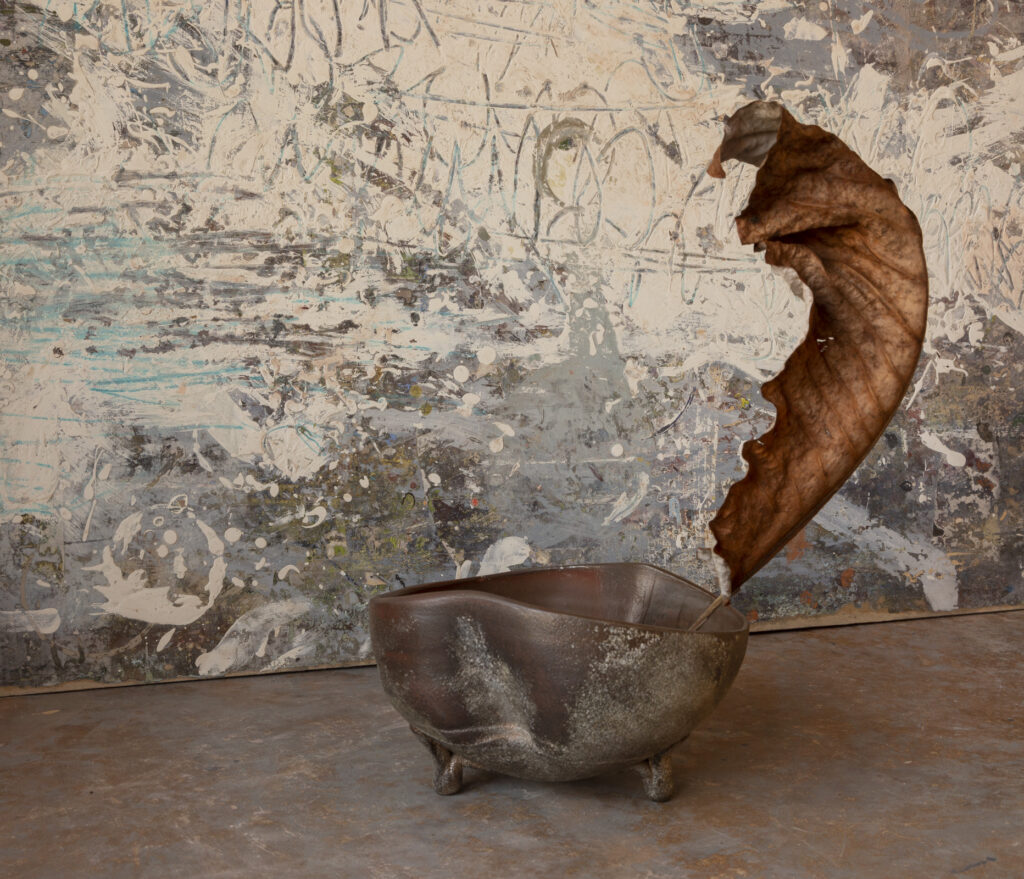
I rustled in slow circles this afternoon looking for just the right leaf. The huge curling litter of our Chinese magnolia is a marker of December for me. The leaves fall like yellow sails in November and then they dry, curl and blow in the wind. There was the year my father was visiting and in his failing eyesight he told me our newspapers had littered the field. Another year while stacking the wood kiln, my two helper friends took a break to gather armfuls of leaves. Their enjoyment of the amassed sculptural abundance drew me out of my funk of doubt.
Leaves beginning to rustle now in the dark tree of the self.
–Charles Wright, from “Cicada,” in Chickamauga (Farrar, Straus, and Giroux, 1995)
Welcome to December and the first in a series of 21 images, some memories and a poem or a quote. As is often the case the beginning of December takes me by surprise.
Over the last few years of this project I often get a running start making a few images in advance so I can focus on ideas. This year I shifted an upstairs studio table to a new position so I can photograph with north light. The rest of the room is in disarray but I made a start.
I found boxes of old postcards, piles of letters, boxes of photographs, files from exhibitions, proposals, and notes for teaching jobs. I threw out paper samples and old unused tools. I vacuumed up dust and mouse nests, stink bugs and weird seeds collected for forgotten reasons. I found postage stamps, scissors, labels, brushes and rubber stamps.
I went through the accumulations of things that I used to throw out when I moved every couple of years. I went through memories and wish lists. I found attempts at articles and dreams of books, inspirational clippings and class evaluations, beginnings of paintings and sketches for projects that have been long since completed. There were cool things that could be used for new concoctions but have passed their expiration date. Some remnants of a few projects I got lost in that did not hold up to the test of time. Today was a good day to move on.
heron at twilight
stillness of dark lake séance
old spirit rises
— Greg Sellers, Haiku journal entry, 1 December 2020
Culturally today is the summer solstice and the summit of my series. We finished our firing this afternoon around 4:30. The firing is the summit of another series in my life. Today is the longest day of the year and as much as I love the summer, now I become a little sad to know the daylight hours get shorter from here. We have had hotter firings in terms of air temperature–it was hot firing in the kiln. We have had harder firings in how we had to fight for every degree of heat rise. We are thankful for the friends who are willing to forego some sleep and to wear long sleeve shirts and pants on these hot days. I learned of two deaths today and I am touched by the way both of these people brought meaning to my life. Their voices remind me that lighting a fire or swallowing ice are actions that weave threads of connection and meaning into our lives.
Basho wrote that the life of poetry means lighting a fire in summer, swallowing ice cubes in winter.
The moon is a waning crescent. The skies have been overcast the last couple of nights. Now the fog is floating in, so there are few stars. The kiln is hot and we have been tending, feeding, listening. It is almost as if firing a kiln was like eating stars, hot and peppery, full of patience and anticipation. We stoke, chat, eat, sleep, drink lots of water, and talk about what we get to eat next. More stars, cake? We watch the flame move through the space of the kiln. We look at the ceramic cones (that indicate temperature) and record the pyrometer temperature. At night the flame reaches out of the chimney like a bright mist or tongue.
ANTIDOTES TO FEAR OF DEATH
Sometimes as an antidote To fear of death, I eat the stars.
Those nights, lying on my back, I suck them from the quenching dark Til they are all, all inside me, Pepper hot and sharp.
Sometimes, instead, I stir myself Into a universe still young, Still warm as blood:
No outer space, just space, The light of all the not yet stars Drifting like a bright mist, And all of us, and everything Already there But unconstrained by form.
And sometime it’s enough To lie down here on earth Beside our long ancestral bones:
To walk across the cobble fields Of our discarded skulls, Each like a treasure, like a chrysalis, Thinking: whatever left these husks Flew off on bright wings.
The front of the kiln is bricked up. A propane burner is propped in the base for preheat. Now is the moment when we look around, sit back on our heels and think about the seeds of ideas that are planted in the pots that are slowly warming up in the kiln. I know a lot of my artist and potter friends have found it difficult to work during, first, the pandemic and now the demonstrations and unrest. It’s been an incredibly beautiful spring. We can write about the flowers in our gardens, the weeds that persist with tenacity, and the creativity displayed in the way that they spread. We can look at nature not just to seek respite from the psychic battlefield, but also as a means to continue.
Dandelions
HOW CAN BLACK PEOPLE WRITE ABOUT FLOWERS AT A TIME LIKE THIS
dear reader, with our heels digging into the good mud at a swamp’s edge, you might tell me something about the dandelion & how it is not a flower itself but a plant made up of several small flowers at its crown & lord knows I have been called by what I look like more than I have been called by what I actually am & I wish to return the favor for the purpose of this exercise. which, too, is an attempt at fashioning something pretty out of seeds refusing to make anything worthwhile of their burial. size me up & skip whatever semantics arrive to the tongue first. say: that boy he look like a hollowed-out grandfather clock. he look like a million-dollar god with a two-cent heaven. like all it takes is one kiss & before morning, you could scatter his whole mind across a field.
Warren and I finished stacking our kiln this evening. I often refer to loading the kiln as being similar to doing a three dimensional puzzle. Making pots for that puzzle is both a joy and a knot of a problem. The kiln is an organic whale shape in which the pots sit in and on top of each other. Remembering the clues in order to have enough to fire the kiln is often a quandary. I remember the first time I took responsibility to fire the wood kiln I worked so hard that original effort is stored as a form of muscle memory.
I once had a helper ask me, “how do you plan for stacking this kiln.” I told her I make drawings and lists and then I dream about it. Sometimes planning for the firing feels like filling the inside of piano. At other times it’s more like shopping in a bodega. Today I felt like my whole body was in overdrive and I could not ascertain which direction or which object would solve the riddle of finishing the stack. Stacking our kiln is not a race, nor an equation or a formula. It comes together like a poem with balance, flow, and direction–a specific seasoning for this cycle of work. There are plenty of pots remaining, a good head start to firing a gas kiln in the near future.
THE PROBLEM
You are trying to solve a problem. You’re almost certainly halfway done, maybe more.
You take some salt, some alum, and put it into the problem. Its color goes from yellow to royal blue.
You tie a knot of royal blue into the problem, as into a Peruvian quipu of colored string.
You enter the problem’s bodegas, its flea markets, souks. Amid the alleys of sponges and sweets, of jewelry, spices, and hair combs, you ponder which stall, which pumpkin or perfume, is yours.
You go inside the problem’s piano. You choose three keys. One surely must open the door of the problem, if only you knew only this: is the quandary edible or medical, a problem of reason or grief?
It is looking back at you now with the quizzical eyes of a young, bright dog.
Her whole body pitched for the fetch, the dog wants to please. If only she could ascertain which direction, what object, which scent of riddle, and if the problem is round or elliptical in its orbit, and if it is measured in foot-pounds, memory, or meat.