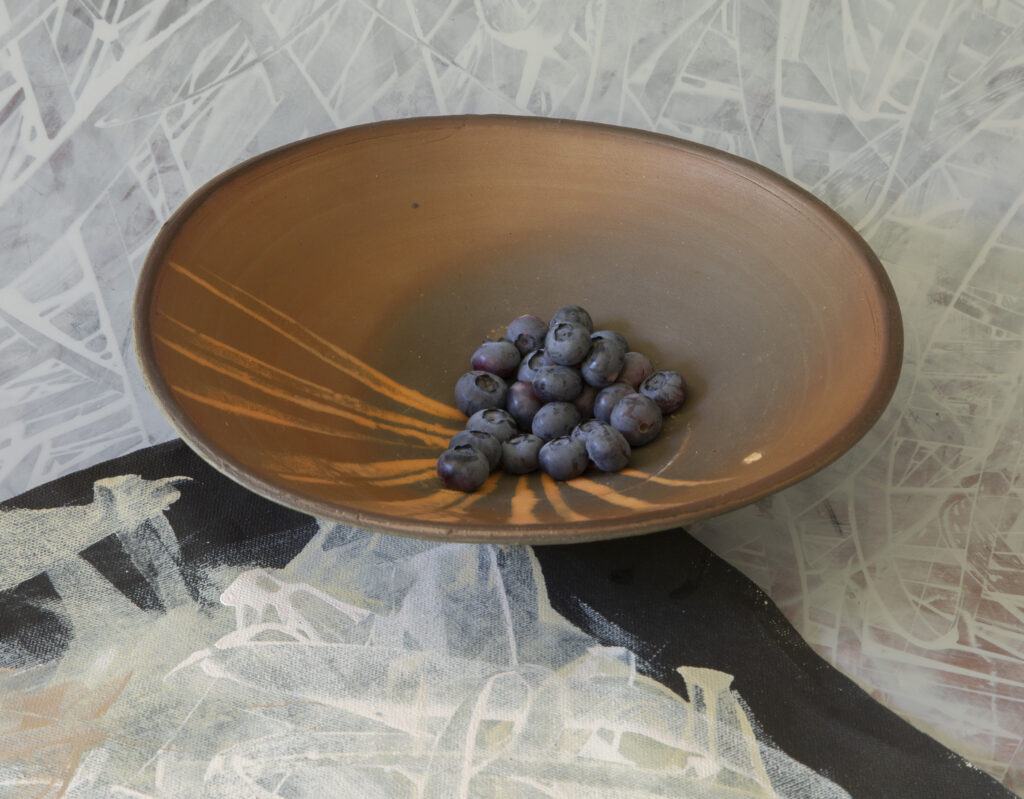
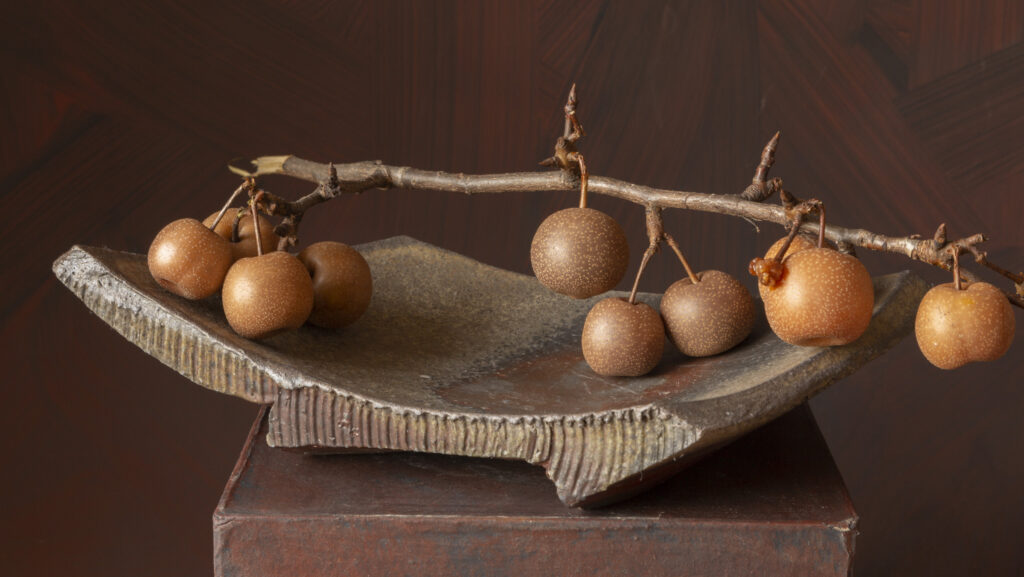
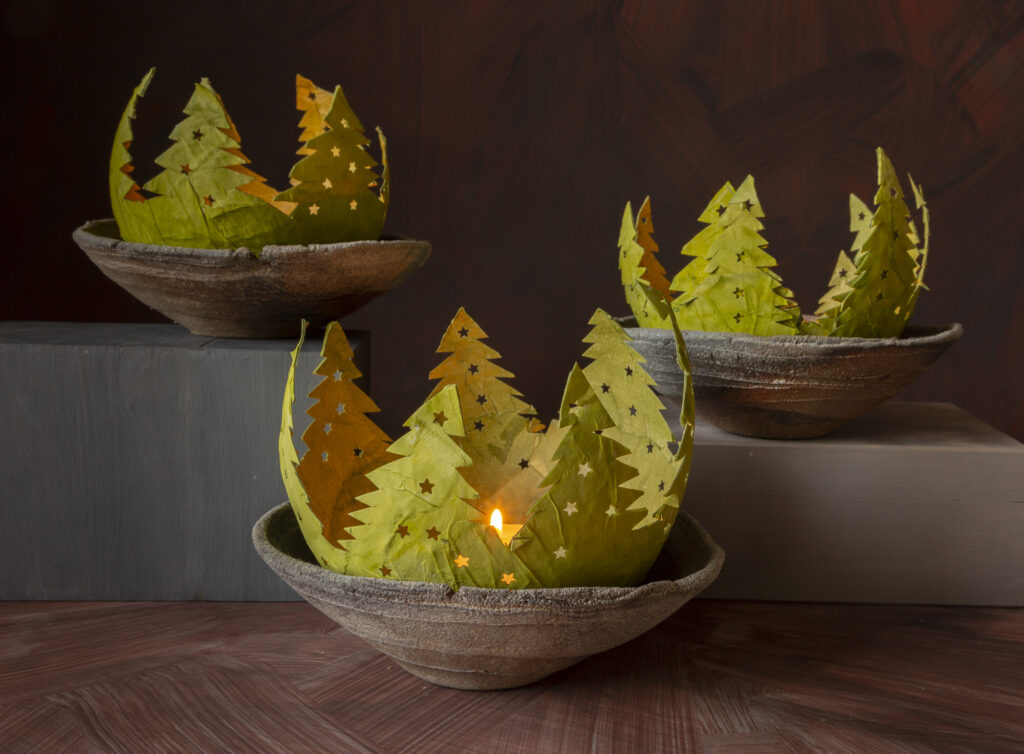
I picked blueberries before breakfast today and meant to bring them with me as a gift. But I think my mind was with the cardinals and the sparrows writing poems on branches. I ate them all before I got to my destination.
“Sometimes lines of poems I’d read long ago would flutter up from the air and perch in my brain like sparrows.”
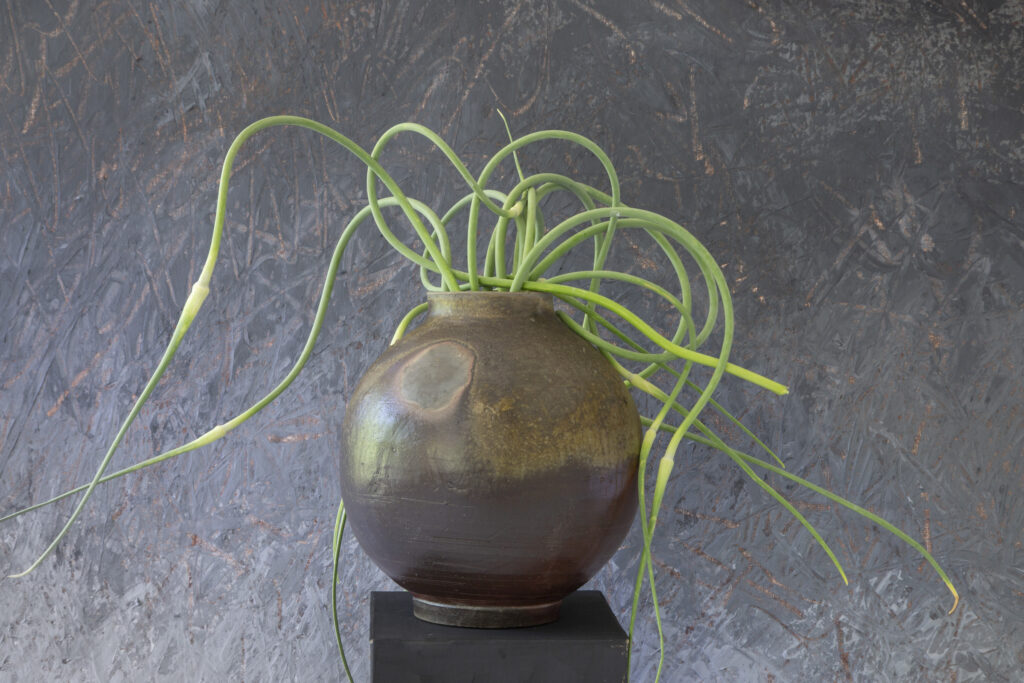
My garlic looks terrible this year. So the scapes in this year’s image were purchased at the local farmers market. I dug up the few bulbs I could find of one variety to use as green garlic (delicious with a Meyer lemon on cauliflower). Next year I will try new garlic in a different location. The other variety I planted might have a few scapes. I think they were hindered by too much rain at the wrong moment. My disordered love for this looping growth thirsts for something I cannot name.
The grass resolves to grow again, receiving the rain to that end, but my disordered soul thirsts after something it cannot name. –Jane Kenyon, from “August Rain, after Haying,” Constance (Graywolf Press, 1993)
Given the news I’ve been in need of local sustenance.
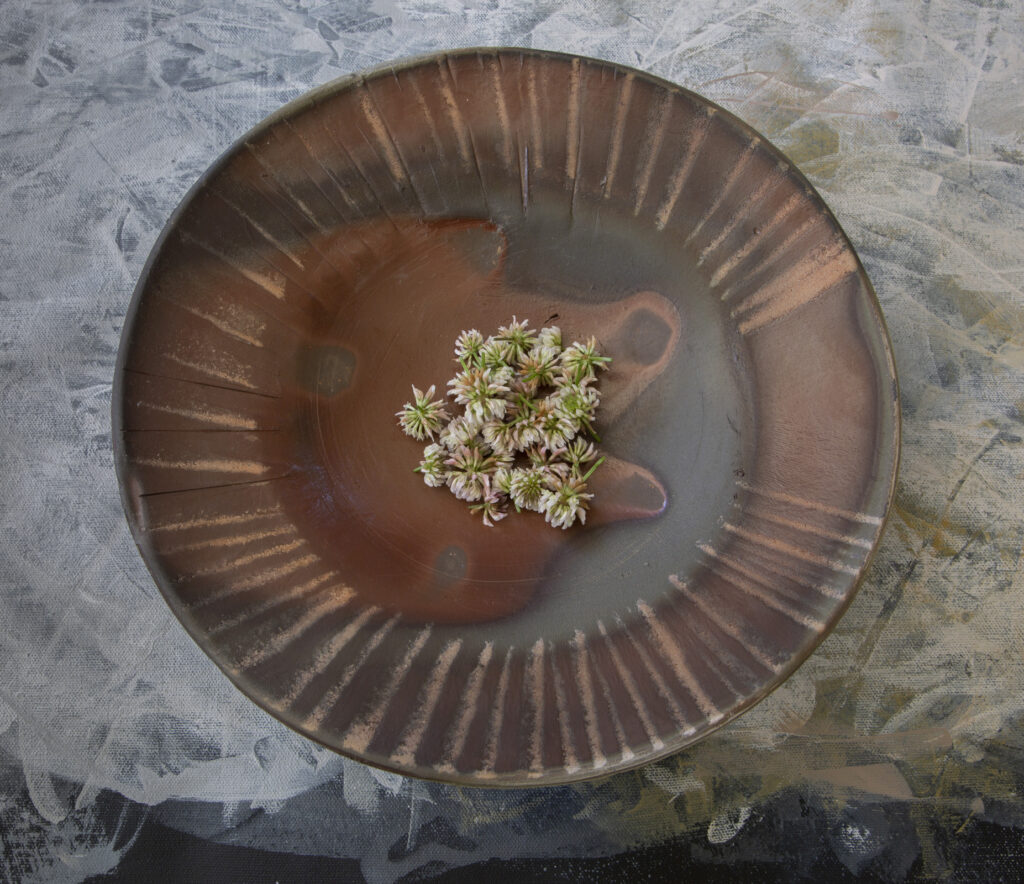
Last week when we got home from the woodfire conference in Star, North Carolina I felt overexposed. We were out of the practice engaging in so much conversation and in so many days of meeting people. I got home and all I could do was mow the grass, leaving untouched a small triangle full of clover and bees. Later I went back and picked a few blossoms, watching my bee friends enjoy the flowers.
In other news around our house the mulberries are ripening. Every time I look out at the mulberry tree there is a young buck with fuzzy antlers eating berries. Every year we have a young buck who we’ve come to call Mulberry. One might think I could come up with another name each year like Shadrack or Buffy or Zanzibar. But Mulberry suits us just fine.
Too Many Daves –by Dr. Seuss (Theodore Geisel)
Did I ever tell you that Mrs. McCave Had twenty-three sons and she named them all Dave? Well, she did. And that wasn’t a smart thing to do. You see, when she wants one and calls out, “Yoo-Hoo! Come into the house, Dave!” she doesn’t get one. All twenty-three Daves of hers come on the run! This makes things quite difficult at the McCaves’ As you can imagine, with so many Daves. And often she wishes that, when they were born, She had named one of them Bodkin Van Horn And one of them Hoos-Foos. And one of them Snimm. And one of them Hot-Shot. And one Sunny Jim. And one of them Shadrack. And one of them Blinkey. And one of them Stuffy. And one of them Stinkey. Another one Putt-Putt. Another one Moon Face. Another one Marvin O’Gravel Balloon Face. And one of them Ziggy. And one Soggy Muff. One Buffalo Bill. And one Biffalo Buff. And one of them Sneepy. And one Weepy Weed. And one Paris Garters. And one Harris Tweed. And one of them Sir Michael Carmichael Zutt And one of them Oliver Boliver Butt And one of them Zanzibar Buck-Buck McFate … But she didn’t do it. And now it’s too late.
Today was the kind of day when shadows spoke many languages. There were green words with graphic edges, elongated shapes, faded patterns and more. At the beginning of the pandemic I gave myself small drawing assignments so that I would pay attention to fence lines, tree branches, clouds, or horizon lines. Then, at the end of the day I would make four small, quick sketches. I have kept up the four-sketch habit, but the focus is more on the day’s activities. Today’s crispness was a great reminder of the value of simple personal assignments.
I THINK
I will write you a letter, June day. Dear June Fifth, you’re all in green, so many kinds and all one green, tree shadows on grass blades and grass blade shadows. The air fills up with motor mower sound. The cat walks up the drive a dead baby rabbit in her maw. The sun is hot, the breeze is cool. And suddenly in all the green the lilacs bloom, massive and exquisite in color and shape and scent. The roses are more full of buds than ever. No flowers. But soon. June day, you have your own perfection: so green to say goodbye to. Green, stick around a while. — James Schuyler
Today was a perfect June day. Cool temperatures for this time of year mixed with blue sky and small clouds. Warren and I drove over the Blue Ridge mountains to revisit a kiln we have fired many times helping out a good friend. The hills of Virginia flowed with tall grass. It was as if each new view melted into the next. As we drove there and back each vista was layered with memories and the fresh light of a clear June day.
June Wind
Light and wind are running over the headed grass as though the hill had melted and now flowed.
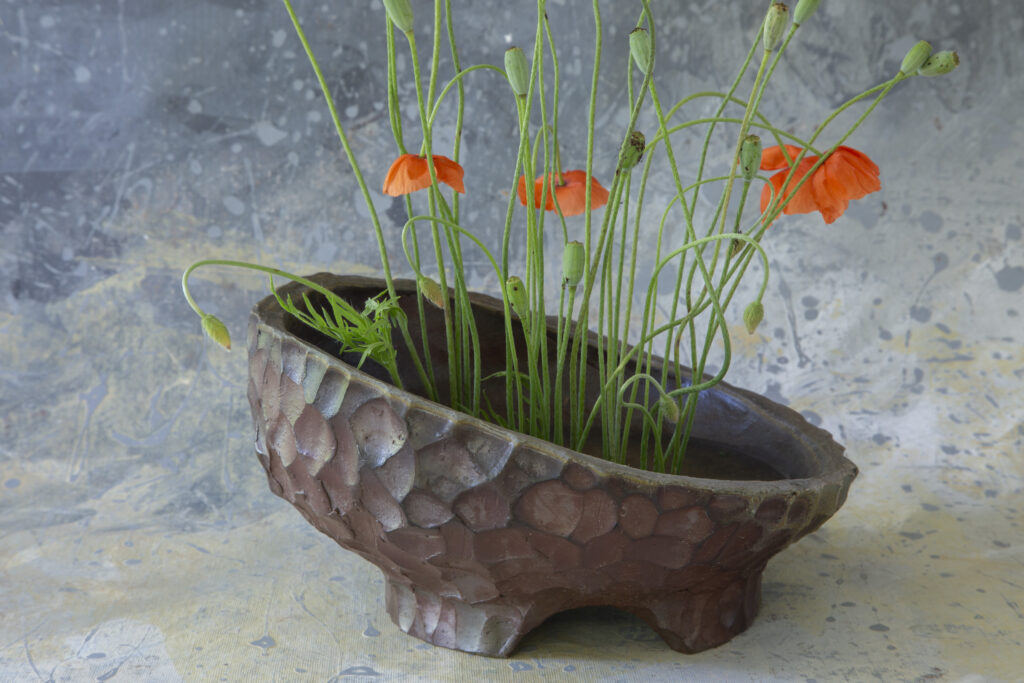
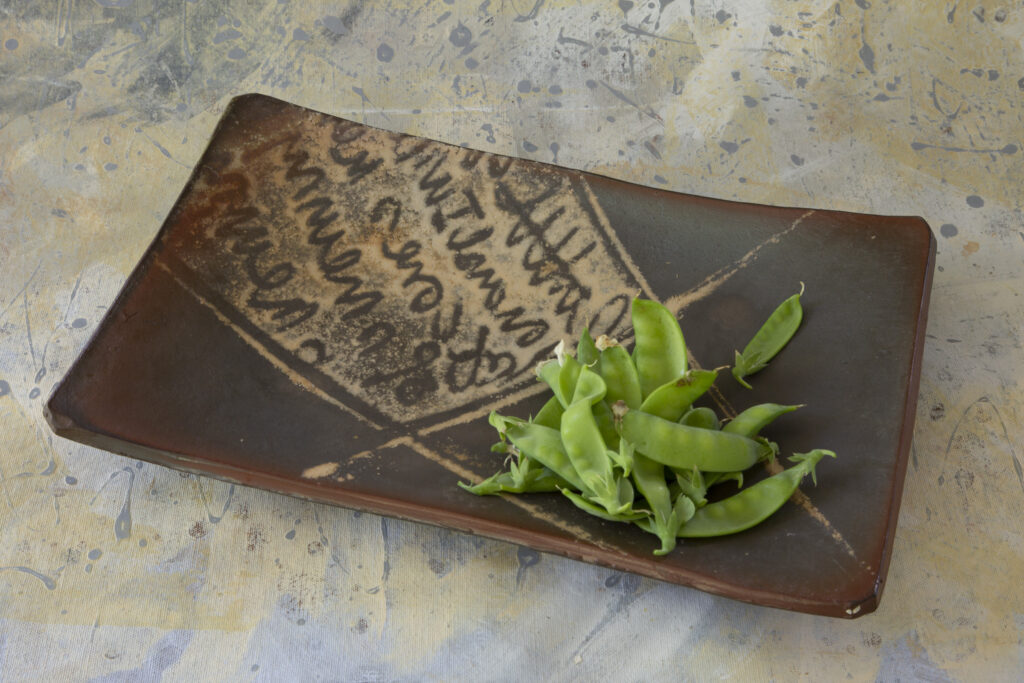
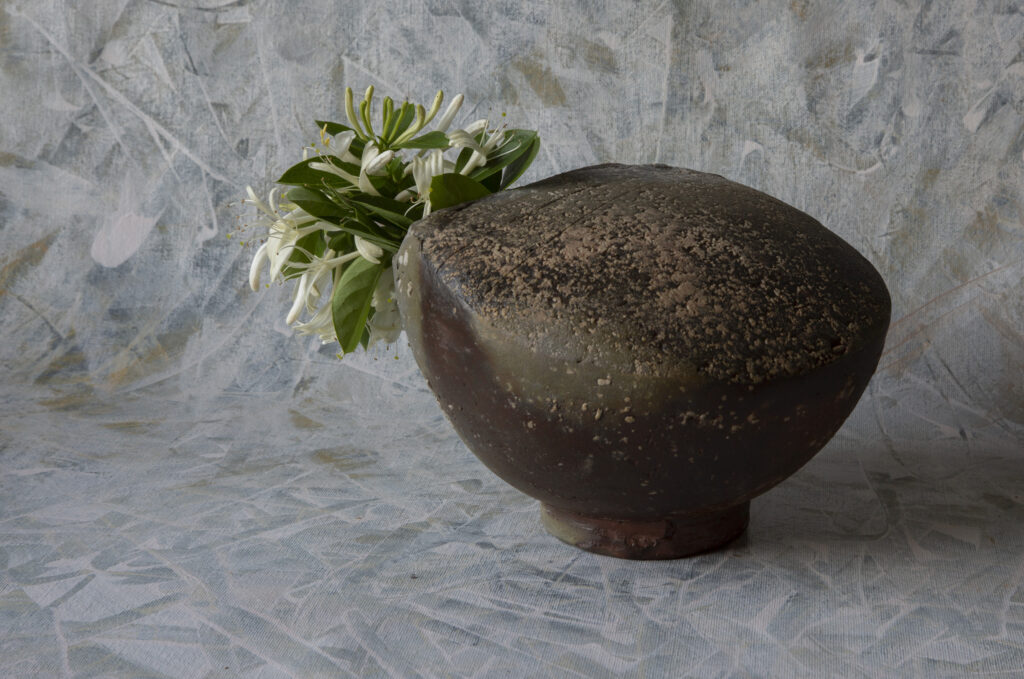
Making these photographs of pottery with combinations of food, flowers and painted backgrounds is like writing a late spring visual letter. The peas are the star of the garden at the moment. I want to nominate their crisp flavor to be a holiday. Putting them on a plate becomes a constellation mixing painting and June air.
“It is your duty in life to save your dream.”
― Amedeo Modigliani (1884-1920, Italian painter/sculptor working in France)
I want to be that friend who can look at something and say that it is a poem. Perhaps a single pea in a plate, a cup on the table, an abstract patterned wall in a parking lot where there used to be a sign, or a magical meal of simple ingredients. When I put flowers in a vase I am not following instructions for a utilitarian object but paying attention to the syntax of the object, its contents, and the surroundings. I want to be like ee cummings who says “Yes” to both the poem and the tangible things on the table.
[since feeling is first]
since feeling is first
who pays any attention
to the syntax of things
will never wholly kiss you;

wholly to be a fool
while Spring is in the world

my blood approves,
and kisses are a better fate
than wisdom
lady i swear by all flowers. Don’t cry
—the best gesture of my brain is less than
your eyelids’ flutter which says

we are for each other: then
laugh, leaning back in my arms
for life’s not a paragraph

And death i think is no parenthesis

-- e e cummings
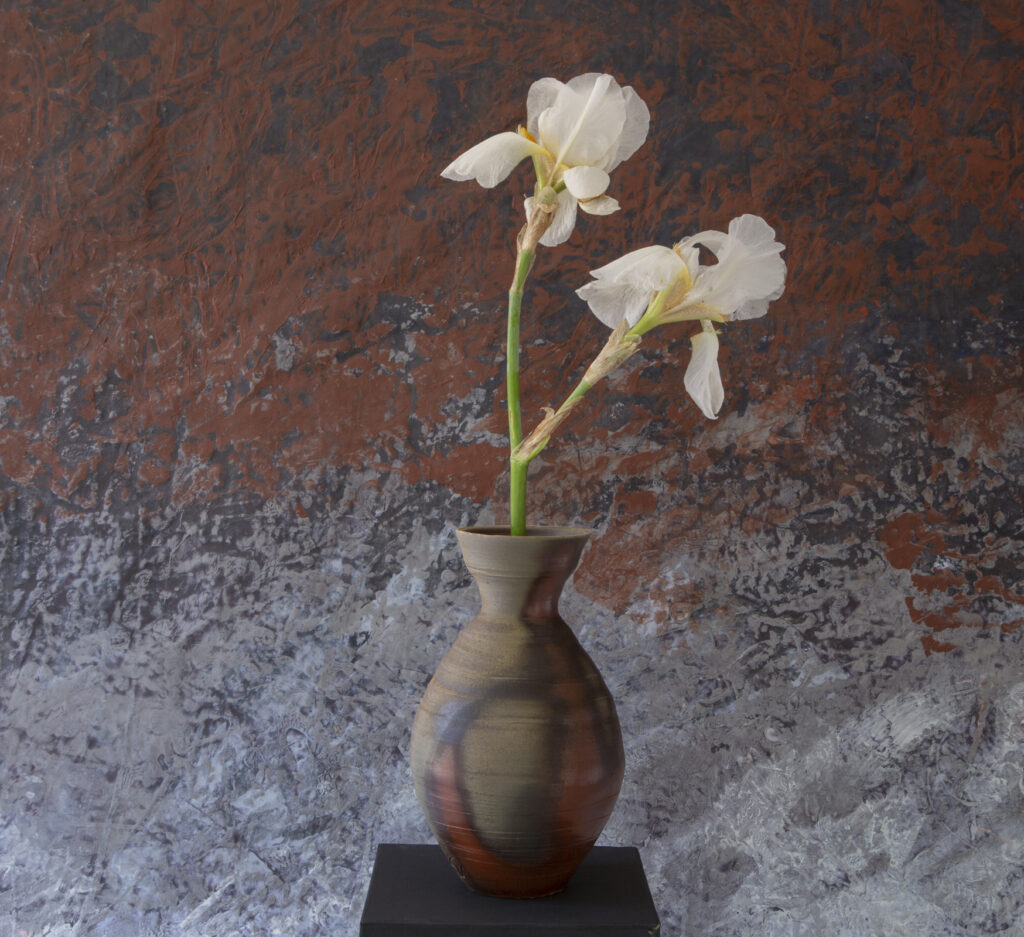
Here is the first of what I hope/plan to be 21 images, a few recollections and some poems. It’s a group of posts that lead up to the longest day of the year on June 21. It’s always a leap of faith to embark on this project but somehow each year it comes together. Today I managed to capture the last of the white iris in our garden hanging on by a thread in the Virginia heat.
My daughter wrote the other day that they have passed the six week mark with our grandson. Her words partly read: “6 weeks of barely sleeping, 6 weeks of balancing plates of food above his little body, 6 weeks of learning each other, 6 weeks of a new identity, … 6 weeks of uncertainty and confidence, fear and love, chaos and silence.”
Six weeks ago was also the last email I had from Mikio in which he conveyed best wishes for Larkin— “A new member of the smiling family…!” He told us to rest well with dreams.
This morning I awoke from confused dreams before it was light and thought, “we did it.” We made it to the shortest day of the year under the moon’s gaze. I tell myself as it gets colder and seems grayer that I will go on walking. During the winter darkness I will watch the birds as well as listen to the coyotes and the geese. I look forward to getting back to clay work in the studio. Although it doesn’t feel like it yet the days will get longer. I will light candles and fires as a coping mechanism. Last year I began to think of time in six week chunks. Six weeks from now is the lunar new year, and a little more than six weeks after that is the equinox.
Tell yourself as it gets cold and gray falls from the air that you will go on walking, hearing the same tune no matter where you find yourself— inside the dome of dark or under the cracking white of the moon’s gaze in a valley of snow. Tonight as it gets cold tell yourself what you know which is nothing but the tune your bones play as you keep going. And you will be able for once to lie down under the small fire of winter stars. And if it happens that you cannot go on or turn back and you find yourself where you will be at the end, tell yourself in that final flowing of cold through your limbs that you love what you are.
I walked through the trees this afternoon looking for nests in the bare branches. For understanding the vulnerability I was feeling I wanted to find clues in the twigs nestled and woven in-between branches. I found a nest high up in a forsythia bush mostly made of broken twigs, but also a few pieces of brown tarp. The mix of natural and human ingredients raises questions about how I have come to make my nest in Virginia.
I have collected bird’s nests for many years because I find their construction inspirational. The use of found materials whether it’s horsehair, newsprint, or blue tarp continue to fascinate. No matter if it is moss or twigs the collage instructs me about the structure of my life. I love this house and the pandemic has driven it home more clearly how my intuition and Warren’s engineering have been woven together to make a life.
For so many years I felt lucky to have the fixed orb of my parents’ loft in New York City, a nest where I could land at a moments notice. Omen was so close, only a block away. I could arrive like a bird and settle down into the protective artistic shelter of my parents soulful home. I could walk a couple of blocks and dip into the contrasting heartbeat of city life.
My father liked to go out to lunch once or twice a week by himself when my mom was busy doing her own thing. For many years he liked to go to Elephant and Castle, a restaurant close-by on Prince Street. Mikio also liked to eat there at mid-day. They would sit at either end of the restaurant at their own tables, but trade off buying lunch for each other. My dad and Mikio were very different birds but had a great appreciation for each other.
“The old books on birds that lined my childhood shelves described nests as ‘bird homes’. This confused me. How could a nest be a home? Back then I thought of homes as fixed, eternal, dependable refuges. Nests were not like that: they were seasonal secrets to be used and abandoned. But then, birds challenged my understanding of the nature of home in so many ways. Some spent the year at sea, or entirely in the air, and felt earth or rock beneath their feet only to make nests and lay eggs that tied them to land. This was all a deeper mystery. It was a story about the way lives should go that was somehow like – but not anything like – the one I’d been handed as a child. You grow up, you get married, you get a house, you have children. I didn’t know where birds fitted into all this. I didn’t know where I did. It was a narrative that even then gave me pause.”
–Helen Macdonald from Helen Macdonald: the forbidden wonder of birds’ nests and eggs, The Guardian, September 2017