The garlic scapes in my garden have emerged, a great signal that it must be June. This is one of the clues that reminds me to photograph, write, and hit send. I am planning to post twenty-one images until the solstice.
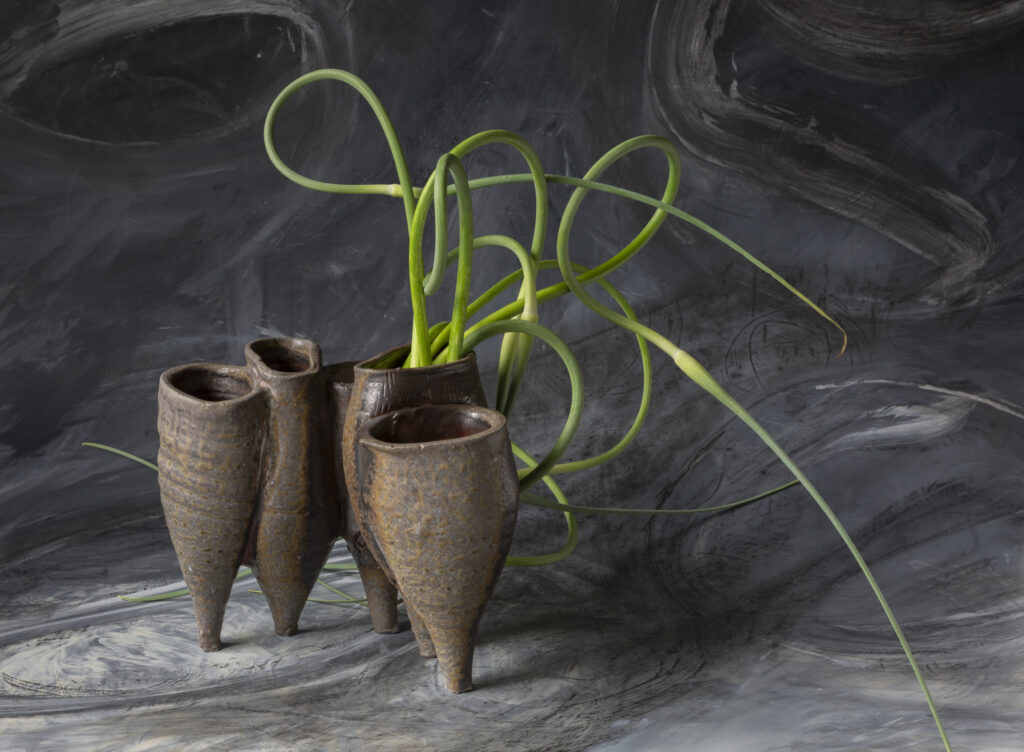
The garlic scapes in my garden have emerged, a great signal that it must be June. This is one of the clues that reminds me to photograph, write, and hit send. I am planning to post twenty-one images until the solstice.
I love this moment in the season of equality, when both the day and night are the same length. I enjoy firing the wood kiln at this point in the year when the night shift doesn’t feel endless. Today, I went out in the morning light with my coffee. It was sixty degrees. The world was wet and seemed full of potential as the crows recited their ebony poems. Spring is always about beginning again on our unfinished pages.

Why Are Your Poems So Dark?
Isn’t the moon dark too,
most of the time?
And doesn’t the white page
seem unfinished
without the dark stain
of alphabets?
When God demanded light,
he didn’t banish darkness.
Instead he invented
ebony and crows
and that small mole
on your left cheekbone.
Or did you mean to ask
“Why are you sad so often?”
Ask the moon.
Ask what it has witnessed.
—Linda Pastan, in Poetry, 2003

Happy winter solstice! Here is the last post of this decembrance series. I made sure to get outside before sunset to walk the dog and then light a small bonfire. The daily effort to photograph, write, and find a poem is never easy. But the poems freshen my eyes, renewing my local landscape, rejuvenating my language to express ideas that move beyond conventional beauty. I am looking forward to our lengthening days.

You told me you couldn’t see
a better day coming,
so I gave you my eyes.
—Ted Kooser and Jim Harrison, from Braided Creek: A Conversation in Poetry, Copper Canyon Press, 2003
I found myself barefoot on the frosty porch this morning inspecting the decaying pumpkins that have been there since late September. I decided today was the day to listen to the earth’s voice and send those babies to the compost. It was a great moment (now with boots on) to admire the dormant garden’s splendor and to come inside and see the amazing growth one day brings to an amaryllis.

Thank You
If you find yourself half naked
and barefoot in the frosty grass, hearing,
again, the earth’s great, sonorous moan that says
you are the air of the now and gone, that says
all you love will turn to dust,
and will meet you there, do not
raise your fist. Do not raise
your small voice against it. And do not
take cover. Instead, curl your toes
into the grass, watch the cloud
ascending from your lips. Walk
through the garden’s dormant splendor.
Say only, thank you. Thank you.
—Ross Gay in Against Which, 2006
The wind followed me everywhere today like a big idea that I wasn’t sure what to do with just yet.

Love Poem as Ars Poetica
Because I am the dog who thought
her pain was a location, shuffling in
and out of rooms, trying to escape it,
it forever following along,
you stick with me everywhere — not
you, but the idea. We begin
with something big, water, or the wind, thinking we can shape it
before it all goes wrong.
—Erica McAlpine, in The Country Gambler, 2016 , Shearsman Books, 2016
In my wanderings this month I have photographed the trees against the sky over and over again. In my sketchbooks, I draw patterns inspired by their branch structure, dividing space like the stanzas of poems. I keep picking up locust pods as if they hold a furtive calligraphic language that unlocks the riddle of the season.

Trees are poems
that the earth writes
upon the sky.
—Kahlil Gibran, from Sand and Foam published in 1926
Years ago my mom gave me a pin that said, “learn to read poetry.” I, in turn, gave her a postcard that I made saying, “learn to read pottery.” Recently, in the cold weather I have often made tea not because I wanted to drink it but because I wanted to hold the warm cup. The poetry of pottery is what we make of the dirt. The poetry is best communicated through our touch and use and yet I continue to take photographs.

I Believe
Poetry, I tell my students,
is idiosyncratic. Poetry
is where we are ourselves
(though Sterling Brown said
“Every ‘I’ is a dramatic ‘I’”),
digging in the clam flats
for the shell that snaps,
emptying the proverbial pocketbook.
Poetry is what you find
in the dirt in the corner,
overhear on the bus, God
in the details, the only way
to get from here to there.
Poetry (and now my voice is rising)
is not all love, love, love,
and I’m sorry the dog died.
Poetry (here I hear myself loudest)
is the human voice,
and are we not of interest to each other?
—Elizabeth Alexander, in American Sublime, Graywolf Press, 2005
In the pale daylight just before sunset I walked in silence. Our dog loves everything she can find in the ditches filled with dead weeds. I had the road to myself, as I moved through this season. In the quiet routine of getting outside, the trees stood tall and the patterns of branch structure whispered hints of solutions to the studio questions I had tousled with this afternoon. I stopped for a moment and in that stillness I leaned in with my whole body to the significance of cold and the coming night.

Winter Grace
If you have seen the snow
under the lamppost
piled up like a white beaver hat on the picnic table
or somewhere slowly falling
into the brook
to be swallowed by water,
then you have seen beauty
and know it for its transience.
And if you have gone out in the snow
for only the pleasure
of walking barely protected
from the galaxies,
the flakes settling on your parka
like the dust from just-born stars,
the cold waking you
as if from long sleeping,
then you can understand
how, more often than not,
truth is found in silence,
how the natural world comes to you
if you go out to meet it,
its icy ditches filled with dead weeds,
its vacant birdhouses, and dens
full of the sleeping.
But this is the slowed-down season
held fast by darkness
and if no one comes to keep you company
then keep watch over your own solitude.
In that stillness, you will learn
with your whole body
the significance of cold
and the night,
which is otherwise always eluding you.
—Patricia Fargnoli, in Winter, Hobblebush Books, 2013
Here a warm cup on a cold day in the studio.
Here spilled seeds saved for next year.
Here the cancelled appointment.
Here the beautiful sunset.
Here the cold toes when I come back into the house.
Here sitting by the wood stove in our basement.

Here
Here a snail on a wet leaf shivers and dreams of spring.
Here a green iris in December.
Here the topaz light of the sky.
Here one stops hearing a twig break and listens for deer.
Here the art of the ventriloquist.
Here the obsession of a kleptomaniac to steal red pushpins.
Here the art of the alibi.
Here one walks into an abandoned farmhouse and hears a
tarantella.
Here one dreamed a bear claw and died.
Here a humpback whale leaped out of the ocean.
Here the outboard motor stopped but a man made it to this
island with one oar.
Here the actor forgot his lines and wept.
Here the art of prayer.
Here marbles, buttons, thimbles, dice, pins, stamps, beads.
Here one becomes terrified.
Here one wants to see as a god sees and becomes clear amber.
Here one is clear pine.
—Arthur Sze, from The Redshifting Web: Poems 1970-1998
To enjoy these cold December days I cultivate the mind of winter. I put on my layers for short dog walks. The loops are quicker, around the property and across the dam with the wind to my back. I walk, paying attention to the details. There are patches of snow on the pond ice. Seven swans fly overhead. I tuck my head into my hood while making mental lists of the trees, noticing the grasses dusted with snow. In the insistent breeze a few leaves skitter across the ice. The studio feels warm compared with the outside temperature, but it is only in the 50s so my hat and vest stay on while I work.

The Snow Man
One must have a mind of winter
To regard the frost and the boughs
Of the pine-trees crusted with snow;
And have been cold a long time
To behold the junipers shagged with ice,
The spruces rough in the distant glitter
Of the January sun; and not to think
Of any misery in the sound of the wind,
In the sound of a few leaves,
Which is the sound of the land
Full of the same wind
That is blowing in the same bare place
For the listener, who listens in the snow,
And, nothing himself, beholds
Nothing that is not there and the nothing that is.
—Wallace Stevens, Poetry Magazine, 1921